Before this semester started, I was wandering through a book stall in the mall. They had a bunch of tables set up with random books. Usually these types of book sales are cheaper than the regular bookstore, and often they will sell the books by weight so you can get a special deal. It reminds me of library book sales which are one of my favorite things!
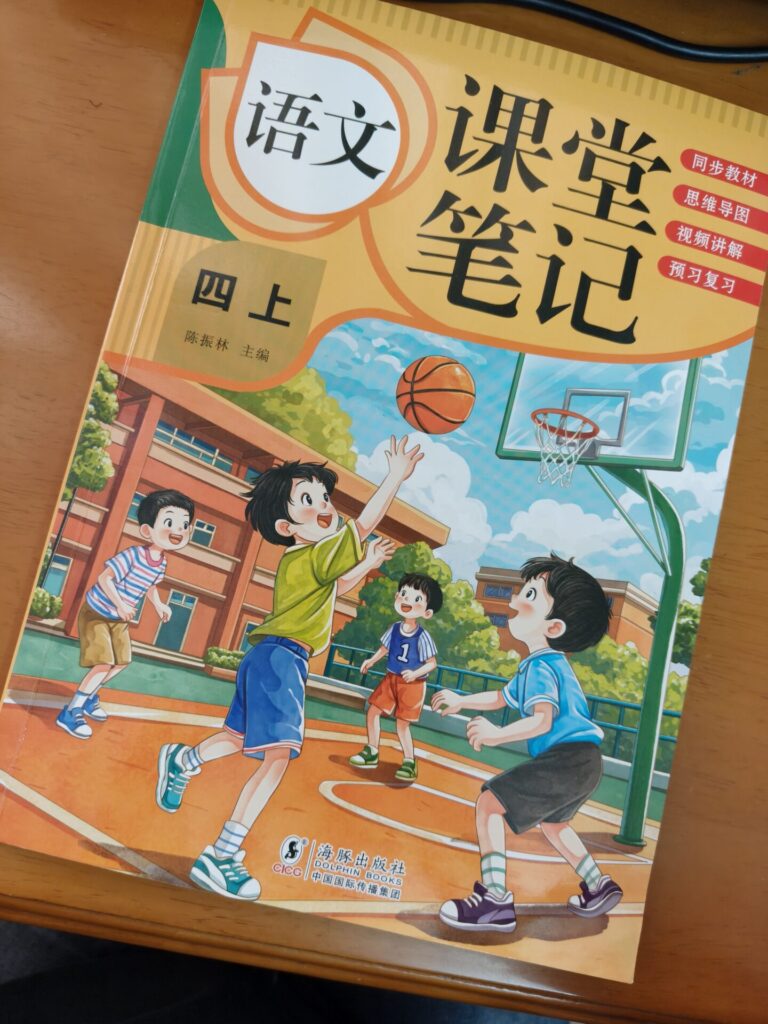
My friend, Shirley, and I browsed the adult books and I recognized a few titles, but I didn’t see anything I needed to buy. Then we wandered through the kid‘s section. I enjoy reading kids books because they’re closer to my level, and usually I can read one in a setting. Then I found a few textbooks. They had the Chinese language/literature textbook for grades 4, 5, and 6. When I found out they were only about $5 altogether, I bought all three of them.
When I have a few minutes during the week, I will read through the texts and explanations. I haven’t made it very far because it’s a busy semester, but I have really enjoyed the first unit which is all about nature and descriptions.
The first selection is about a huge tidal wave (钱塘江大潮, Qian Tang Jiang Da Chao) that floods a river in Zhejiang. The best time to watch, according to tradition, is sometime in October depending on the lunar calendar. At this time, a huge wave comes in and most of the tourists get wet. The tourists are there to watch the wave, and the locals go to watch the tourists. I looked up a couple of videos of the tidal wave, and it looks big and wet!
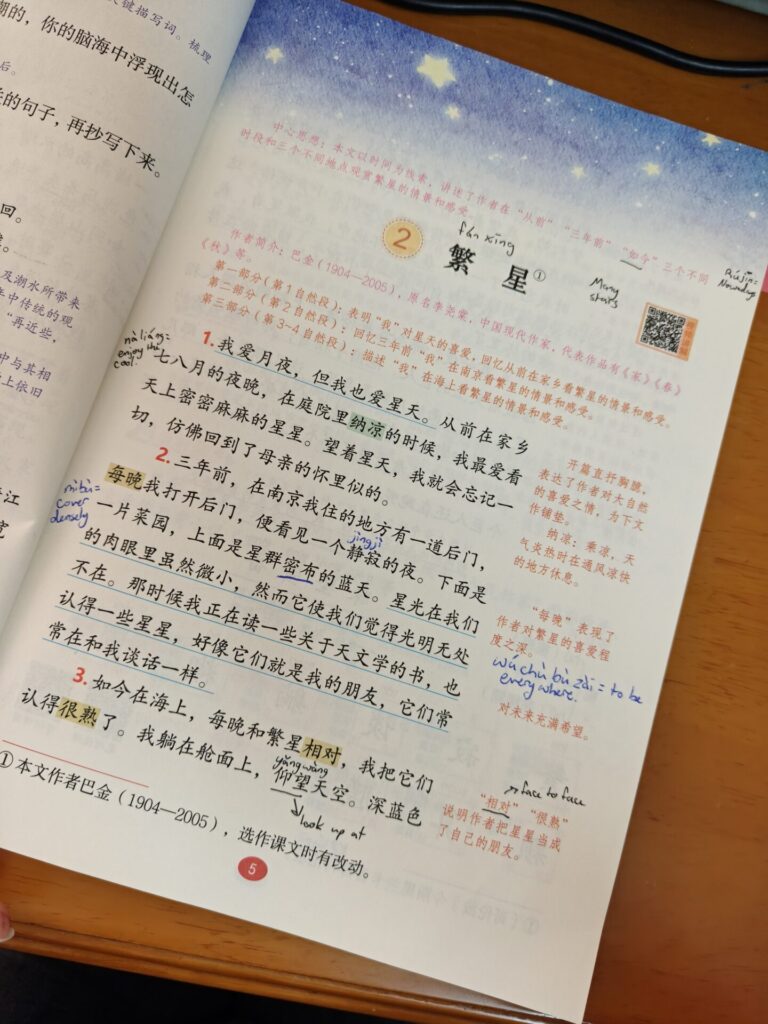
The second selection is called 繁星 (Fan Xing; Vast sky of stars), and I really enjoyed reading about the author’s experience of looking at the sky in various places over the years. I love looking at the stars, and since I haven’t seen the Milky Way in a while, I’m itching to see it again. Few things make me feel as small as looking up at the vastness of space. And while it makes me feel small, it also shows me the power and glory of my great God.
Isaiah challenges us to “Lift up your eyes on high And see who has created these stars, The One who leads forth their host by number, He calls them all by name; Because of the greatness of His might and the strength of His power, Not one of them is missing.” (Isaiah 40:26)
The next section of the book is a couple of poems. I studied them and watched a couple of online videos explaining them. During my Chinese literature class last semester, I discovered that Chinese movie and video streaming services have countless 5-10 minute videos explaining Chinese poems. I enjoy watching them to get a deeper understanding of the poetry. They also make the poems more visual with illustrations.
After the literature selections, the textbook has several discussion and writing activities. Then it has some grammar and vocabulary exercises. One of my favorite sections is here at the end, and it was pretty unexpected. I found a collection of 8 different idioms.
The first 4 idioms in the list are all related to loud noises, harkening back to the deafening noise of the tidal wave as it comes in and the voices of all the people as they talk in eager anticipation of the coming wave.
All of the idioms are descriptive. 锣鼓喧天 (luo gu xuan tian) refers to the deafening sound of gongs and drums (definitions are from Pleco). 震耳欲聋 (zhen er yu long) is literally referring to your ear shaking since the first character is the same character used in earthquake. So it means deafening or ear-splitting noise. 响彻云霄 (xiang che yun xiao) means to resound across the heavens.
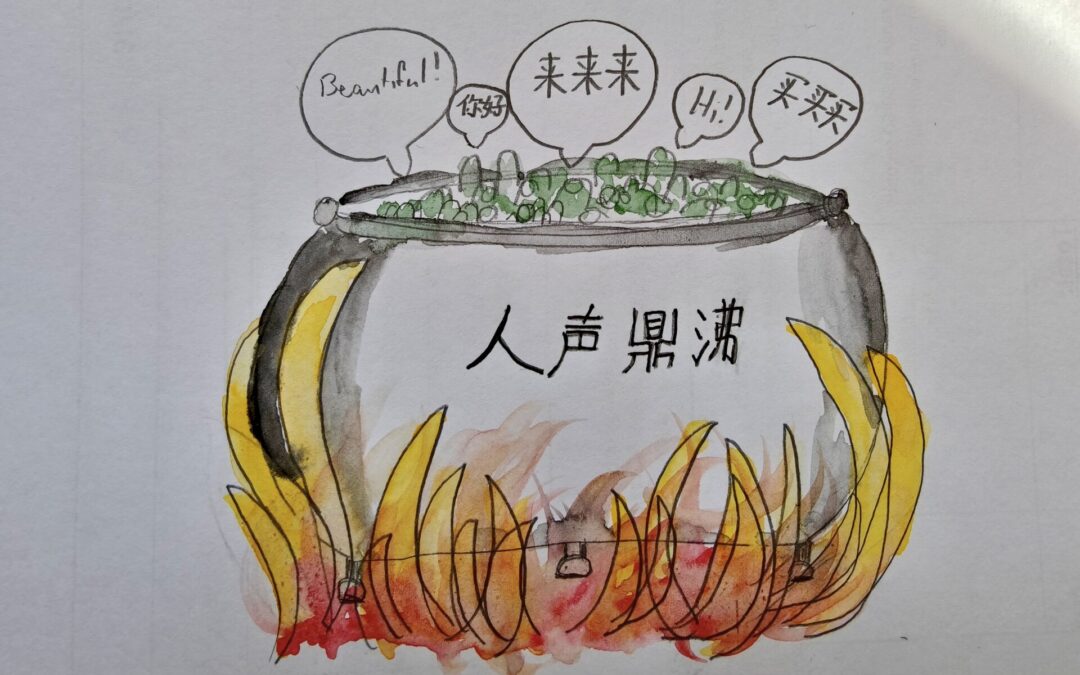
But my favorite one seems the most descriptive: 人声鼎沸 (ren sheng ding fei). This means a boiling cauldron of voices. I love that image because it so perfectly describes how loud a huge crowd is when everyone is talking at once. When you’re in a huge crowd with people pressing in all around you and everyone is talking, it really feels like a boiling cauldron of voices. Good job, Chinese for capturing that idea so perfectly.
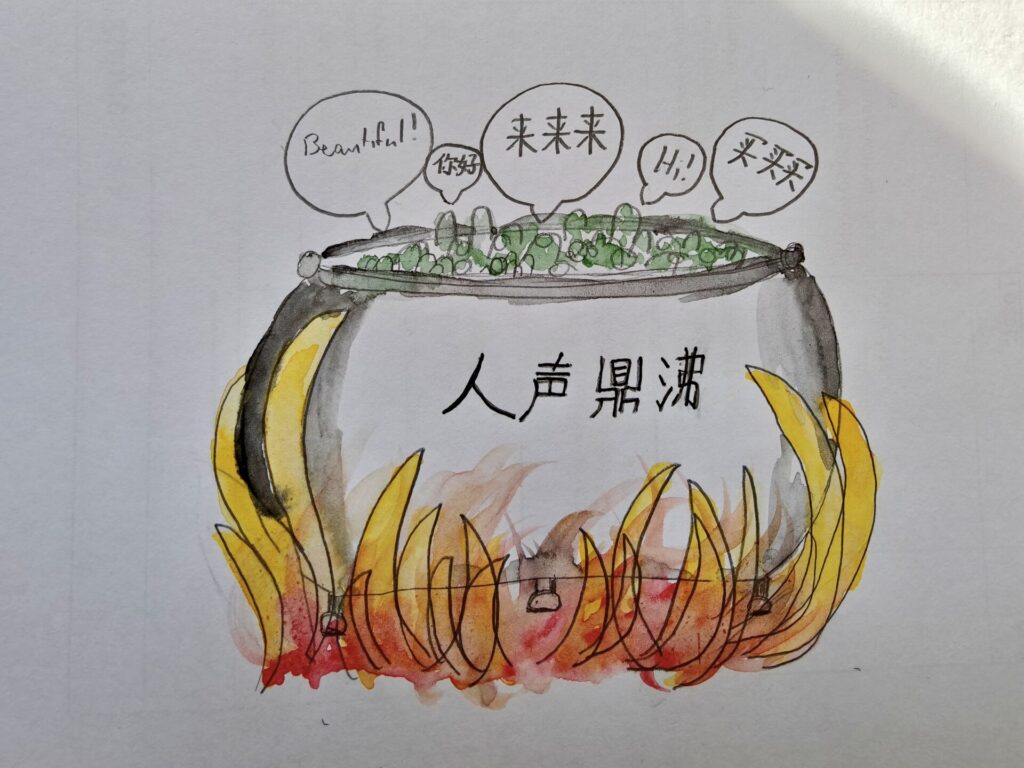
I decided not to try to remember all of the idioms. That sounds too hard. I want to know them enough to recognize them when I see them, but I decided I only need to remember one of them that I want to use. Of course I chose 人声鼎沸. I repeat it in my mind so I remember, and now I’m just waiting for a good chance to use it!
The next 4 idioms are all about being quiet, reminding us of the peace and quiet of looking at the night sky in the countryside.
These ones don’t seem quite as descriptive, but I’ll share them anyway. 低声细语 (di sheng xi yu) means to speak in a soft, low voice. 窃窃私语 (qie qie si yu) means to whisper and the third character is a word for private, so it’s saying a whisper is a private speech. 悄无声息 (qiao wu sheng xi) means quietly or noiselessly.
The one I decided to remember for this list is the one that feels most visual to me: 鸦雀无声 (ya que wu sheng). The first character is talking about a crow—which are often loud birds. The second is the character for sparrow and also part of the word for peacock. The last two characters mean “no sound.” This idiom is literally saying that even the crows and sparrow or peacocks are silent. It’s so quiet not even the birds are singing.
I love the visual elements in these idioms because it helps me to remember them more clearly. For the crow and sparrow being silent idiom, I imagine a duck with a cloth tied around his beak to keep it closed. I know it’s supposed to be a crow, but “ya” with a different character also means duck, and that visual already got stuck in my mind. I’ll put a couple of crows, sparrows, and peacocks with tied beaks around him also to make it more accurate in my mental image.
Please forgive me, I don’t think my drawing skills are quite there yet, so I’m not going to attempt these birds for now, but you can imagine it yourself!