This semester, I’m auditing another Chinese Literature class. Since this class is called Chinese Literature II, I, along with the other students, assumed that the class would be more focused on recent literature. Our class last semester went from ancient Chinese poems all the way through dramas in the 1600s. So we assumed our class this semester would pick up where that left off.
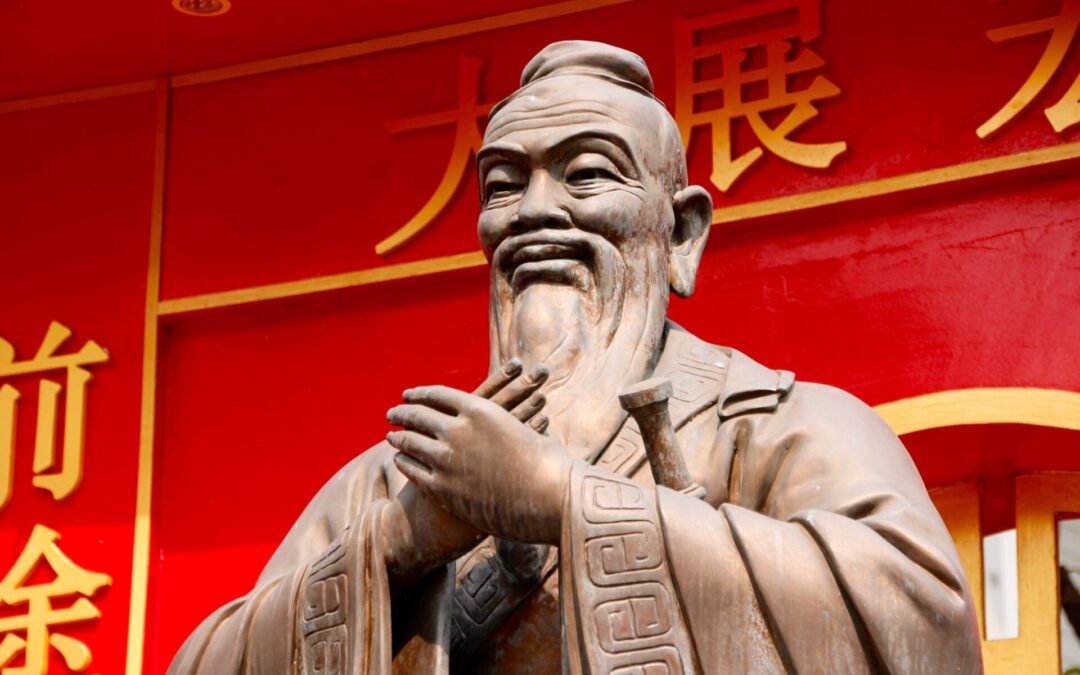
The teacher asked the students what we studied last semester, and when she found out that we hadn’t studied Chinese mythology and much about Confucius (孔子, kongzi), she decided to start there.
I was a little disappointed that after 6 weeks of class, we still haven’t skipped ahead to more modern things, but I did enjoy learning about some of Confucius’s sayings this week, so I’ll share them with you.
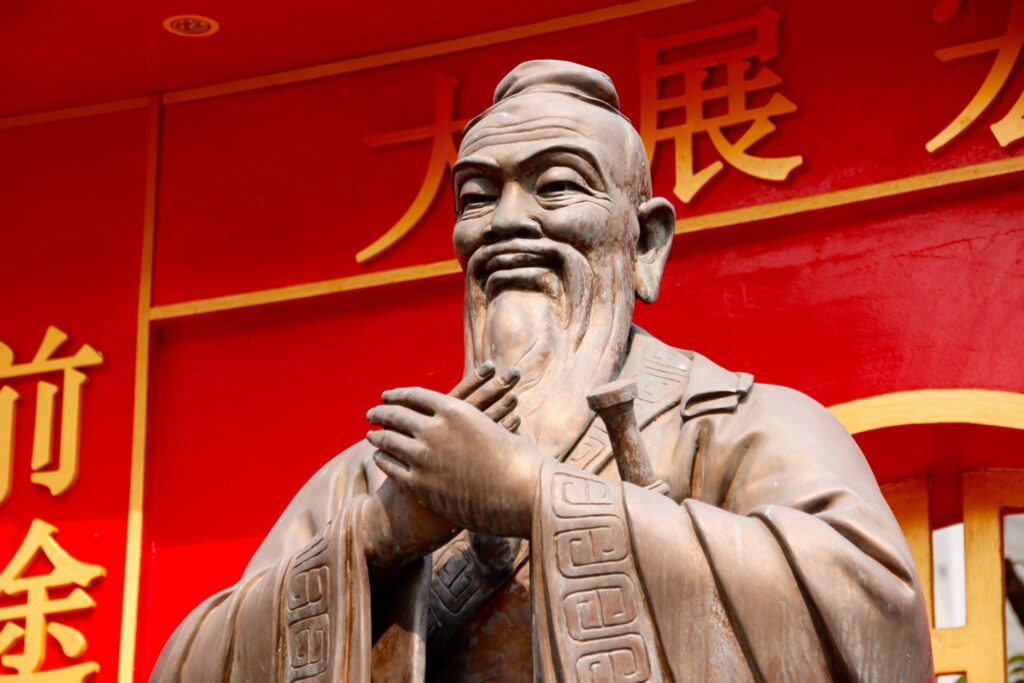
Confucius lived from 551-479 BC. That’s a long time ago! Comparing that to the Bible, that’s after the time Babylon conquered Judah, and around the time Cyrus the Great allowed the Jews to return to their homeland. It’s also around the time Buddha lived, and nearly 100 years before Socrates.
Confucius developed a moral way of thinking that became foundational for Chinese thought. Some people would consider Confucianism a religion, and other would consider him a wise teacher. For now, I just want to look at some of his sayings.
1. 己所不欲, 勿施于人 (ji suo bu yu, wu shi yu ren). According to Pleco, my Chinese-English dictionary, this means: “do not impose on others what you yourself do not desire; do not unto others as you would not have them do unto you.” This one is interesting because it’s very similar to the Golden Rule that Jesus gave us centuries later. Jesus said in Matthew 7:12, “So whatever you wish that others would do to you, do also to them, for this is the Law and the Prophets.”
What I find interesting about these two sayings is that Confucius focuses on the negative—what we should not do, while Jesus focuses on the positive, what we should do. I think both sayings are very wise. But the action of doing something good goes a step further than just not doing something bad.
2. 有教无类 (you jiao wu lei) According to Pleco, “in education there should be no class distinctions; everybody has the right to receive education and can be educated.” This one seems like it would be very popular today with lots of the human rights movements, and I think it’s interesting that Confucius said the same thing 500 years before Jesus was born.
Everyone can and should be allowed to be educated. The Chinese College Entrance Exam (高考, gaokao) puts a lot of pressure on high school students and teachers, but I appreciate one of the goals of this exam—to give equal opportunities to all Chinese students. Lots of other factors are also involved, but the idea behind the test is to give every student the same opportunity for education regardless of their background.

3. 温故而知新 (wen gu er zhi xin). This means that one reviews history in order to learn from it. Throughout my education, my teachers talked about the importance of this truth. We need to study history so that we can avoid making the same mistakes. Confucius taught the same thing. And I don’t think this applies just to big things like national or world history. In my own life, I can learn from my past mistakes so that I don’t repeat them.
Several years ago, I taught European Culture, and the first time I taught it, I didn’t prepare for the class during the summer vacation because I wasn’t sure if I would be given materials to use, or if I would have to come up with my own curriculum. At the beginning of the semester, I finally found out that I was expected to create my own curriculum, and I spent the entire semester scrambling to learn enough about European culture to teach a cohesive class about the topic. I enjoyed the class, but it was also stressful. The next time I got a new class, I found out ahead of time if I was going to prepare my own materials, and I spent the break studying and researching so I could be ready. That semester was much more enjoyable even though preparing new curriculums is still a lot of work whether or not I start ahead of time. I am trying to learn from what happened in the past and mistakes I have made so I don’t have to repeat them.
4. 学而不思则罔,思而不学则殆 (xue er bu si ze wang, si er bu xue ze dai). According to Pleco, “learning without thought is labour lost, thought without learning is perilous.” I think this sentence is so interesting. What’s the point of learning without thinking about what I have learned? And I need to be very careful of thinking about things without also learning about them.
One of the reasons that I love my book club with friends is that it forces me to think about the things that I am reading and to discuss them with others. Usually, after I read a book, I will write down a few sentences about what I’ve learned from the book, but discussing the book deeply with other people who also read the book is even more meaningful, and I remember those books more clearly than most of the other ones that I read.
I also need to remember to research my opinions before sharing them blindly. I need to think about where my ideas come from so that I’m not trapped in logical fallacies or blinded by my own biases.
5. 不愤不启 (bu fen bu qi) According to Pleco, “a student shall not be enlightened until he has tried hard by himself.” In English, we use the phrase, “experience is the best teacher.” I like this one because I have seen this with my students. I need to let them try something rather than just lecturing them about it. I try to do this especially in my communication classes. I don’t want to just tell my students about how hard cross-cultural communication is. They might believe me, but they won’t understand unless I put them in those situations.
So I try to create situations for my students where they get to experience the challenges of communication. In my last class, we were talking about the challenges of communication and how people don’t always understand what we say in the way we intend. AI helped me to come up with an activity where I had two students sit back-to-back. I gave one student a geometrical picture, and the other student drew the picture as the first one described it. In the first round, the drawing student could not ask any questions. In the second round, they could ask yes or no questions, and in the third round, they could ask and answer any questions freely. But in no rounds did the picture turn out exactly the same. I used this to help students to see the underlying assumptions that we have even as we try to communicate clearly. After the activity, the students seemed to have a much deeper understanding of this challenge because they had experienced it. I agree with the importance of allowing students to try hard so that they can feel the struggle.
I enjoyed learning some of these sayings from Confucius, and I hope you enjoyed reading about them also. There will be a test next week.
Just kidding! Let me know if you know any others or if you have used any of these in some interesting situations!