
Since I live in Guangzhou (in the Canton area), I have plenty of chances to listen to Cantonese Opera when I’m walking through a park. However, since the music is everywhere, I didn’t realize how often I had heard it until I watched a small Cantonese opera show in the park. A group of older people apparently perform nearly every day. I was in the park with my friend and her family and they were getting ready for a performance when we passed, so we waited a few minutes and then watched the performers.
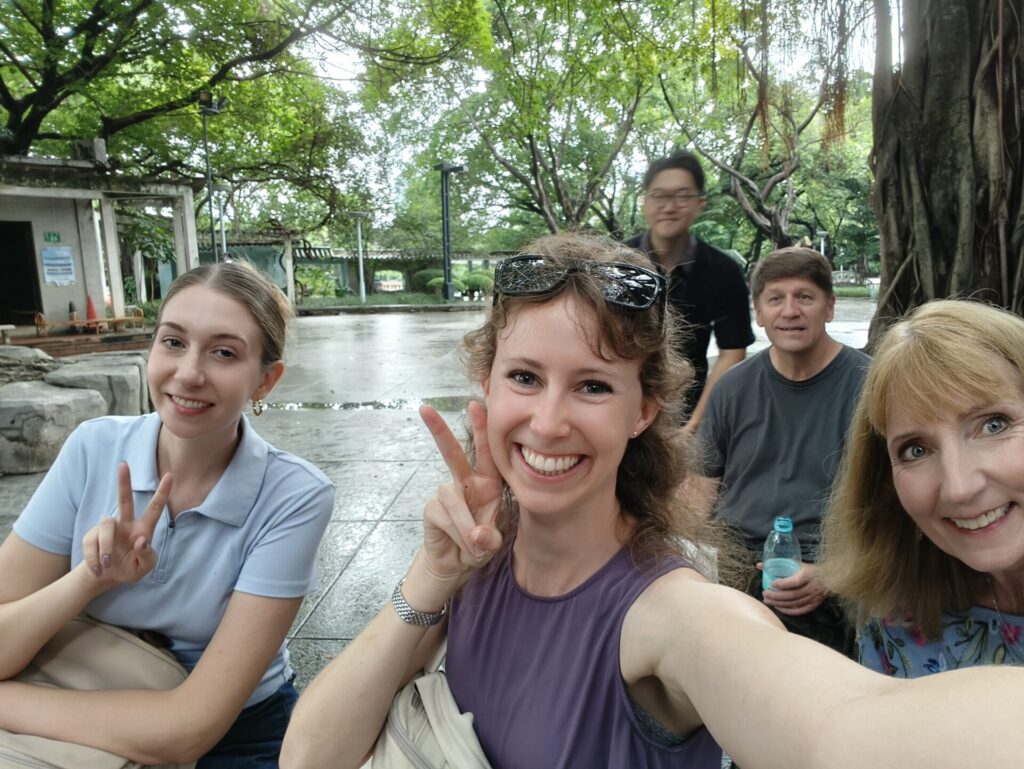
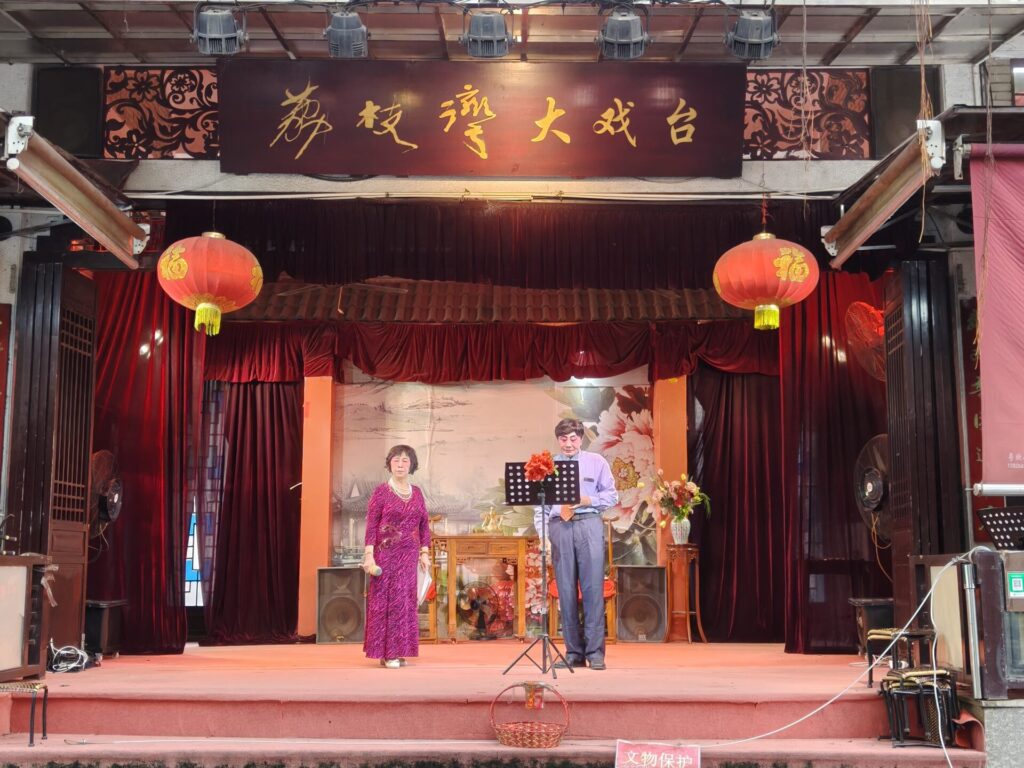
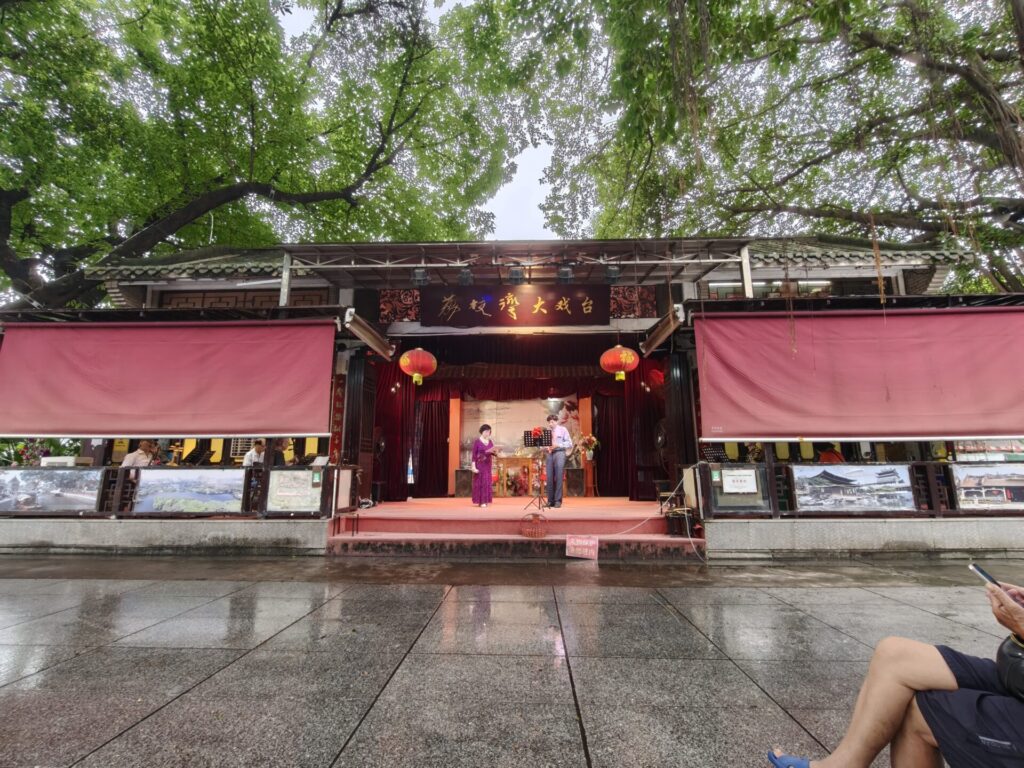
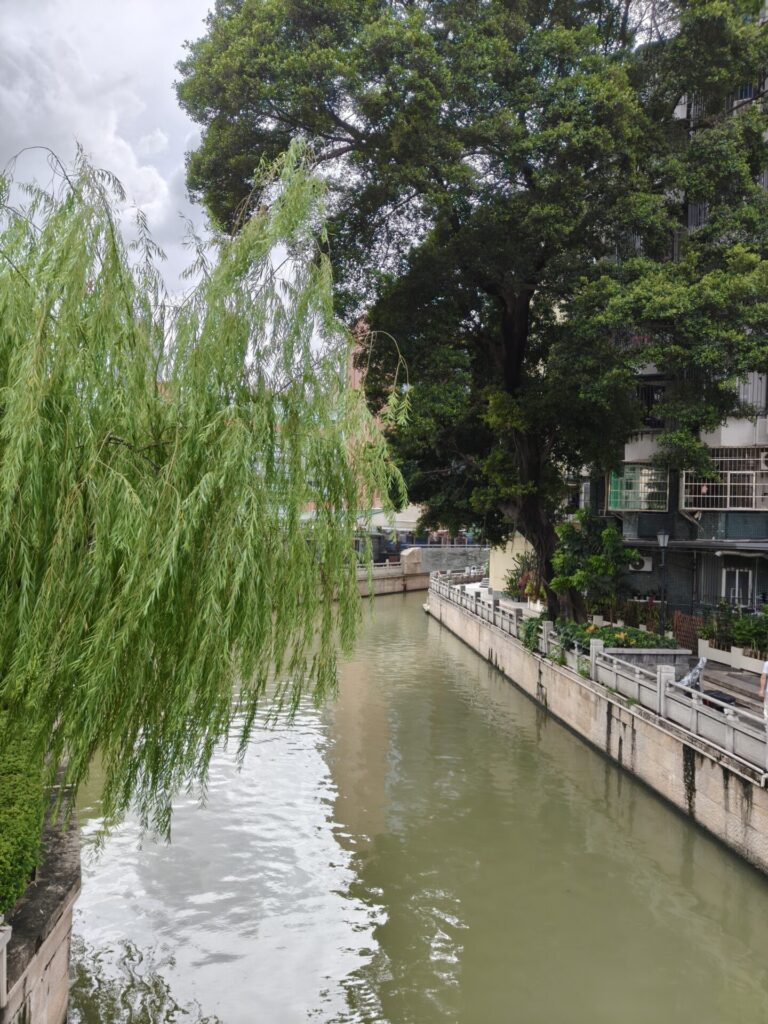
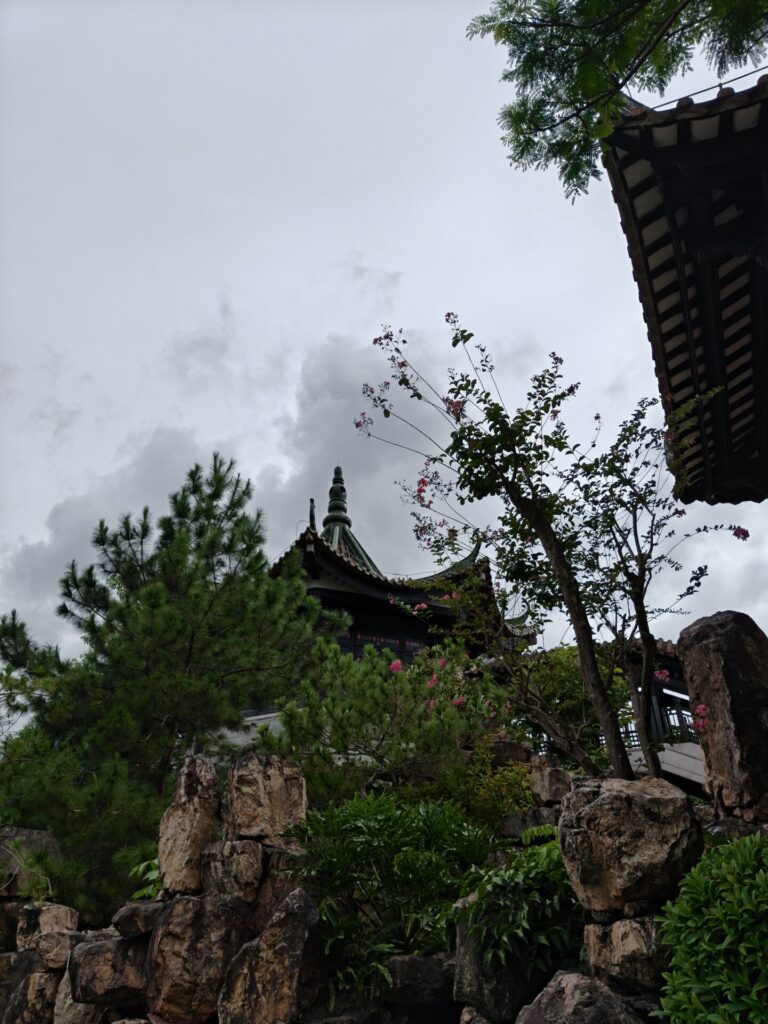
This happens in Liwan park (李湾公园, liwan gongyuan) at 2 p.m. I was there on a Monday, and from what I’ve heard, the performances happen nearly every day. We sat on some plastic stools and listened to the sharp-sounding Cantonese instruments with lots of clicks and clacks and the operatic singers. I don’t speak Cantonese, and Cantonese opera is even hard for some Cantonese people to understand, so we didn’t stay for the whole time.
I debated with myself about whether or not to include the video I took in the park because while this video can give you a taste of Cantonese opera, it’s quite a bit different from a professionally performed opera, as I found out last week. But the video does give a taste of what the style is like.
My students told me about the free opera that we would be able to watch at the big theater next to my campus, and when I realized I was free that evening, I asked a friend to help us get tickets.
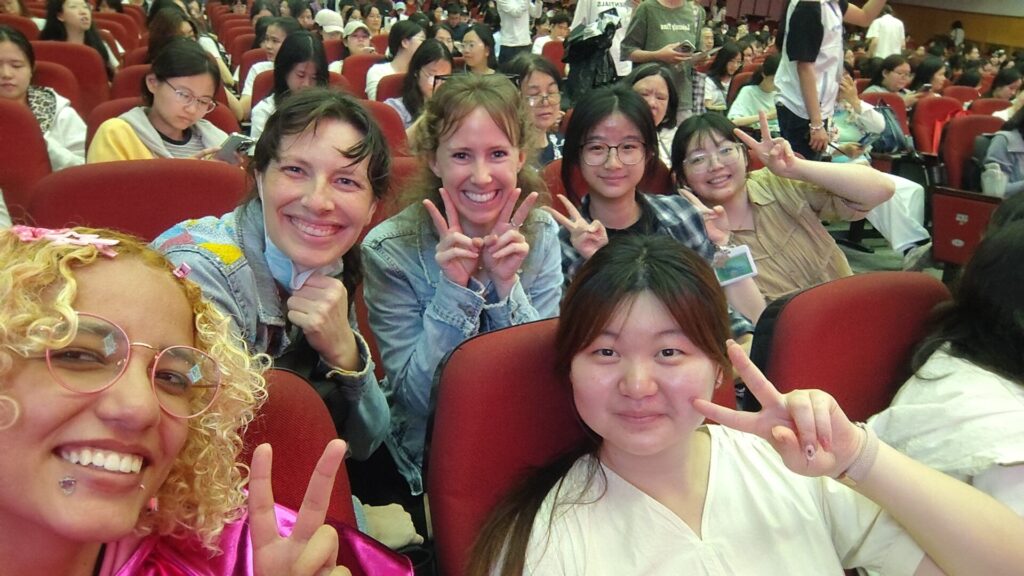
Since the seats were first come, first serve, we arrived early and chatted while we waited for the performance to begin. This time was also the perfect chance to learn a bit about the story, so I looked it up on DeepSeek. The performance was in Cantonese, but this time we had Mandarin subtitles on the side of the stage. But I figured it would still be easier to follow if I had a basic understanding of the story.
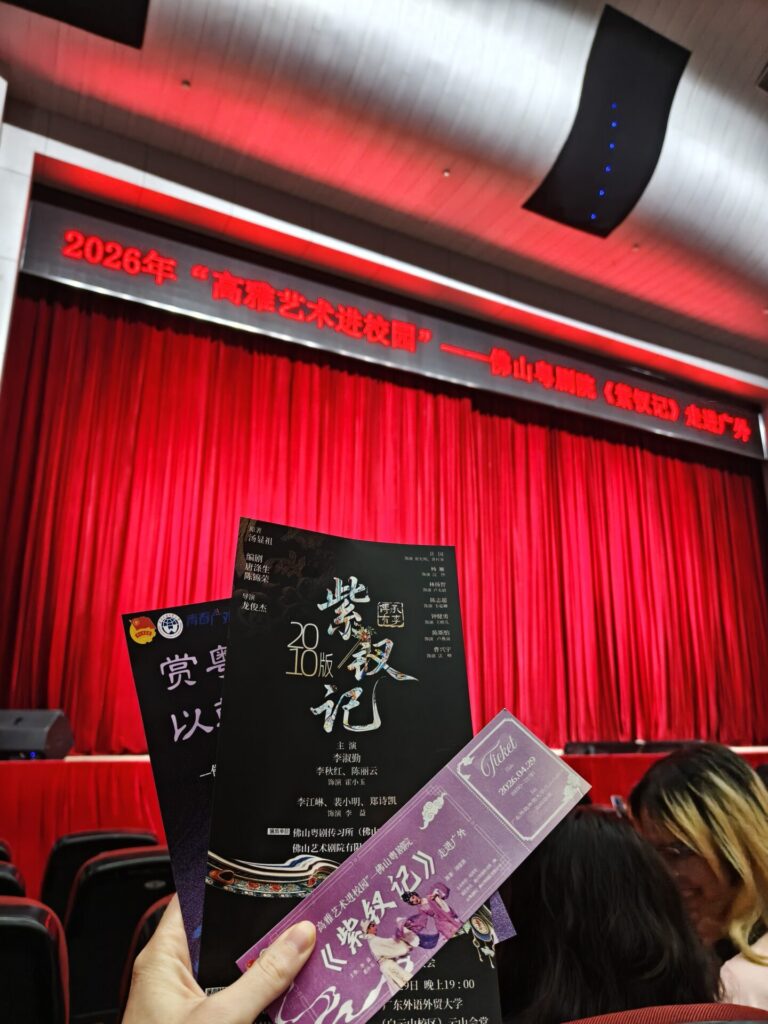
This opera was called 《紫钗记》(The Purple Hairpin, Zichai Ji) and the original version was written by 汤显祖 (Tang Xianzu). The version that we saw had been adapted, and we watched the 2010 version.
The main plot of the story is that 霍小玉 (Huo Xiaoyu) and 李益 (Li Yi) meet and fall in love when Xiaoyu drops her purple hairpin. However, Li Yi makes the antagonist angry by refusing to marry his daughter. That scene was one of my favorites because the girl who wanted to marry him was perfectly annoying and funny. Maybe I also liked it because it was one of the few scenes I could understand even without the subtitles. As punishment for refusing to marry his daughter, he sent Li Yi away for three years.
Xiaoyu had the purple hairpin, but for some reason, she sold it. DeepSeek says that she sold it because she thought that Li Yi had been unfaithful to her, and so she was giving up on their relationship. In the opera that we saw, it seemed more like she sold it because she was desperate for money. Whatever the reason, she sold it, and the antagonist bought it and showed it to Li Yi. When Li Yi saw that Xiaoyu had given up the precious hairpin, he also wondered if she still loved him.
The antagonist had a white face (his make-up was white, or it might have been a mask), and he also had some black lines painted on. I was glad that during the performance, my student leaned over and whispered that white faces represented bad characters and red faces represented good characters. I should have guessed that based on the positive use of red in much of Chinese culture, but since I was still stuck behind my cultural assumptions, I would have guessed the opposite.
Evil white-faced character tried to separate Li Yi and Xiaoyu until a noble red-faced character came along to help them. This man pushed the hero and heroine back together, reuniting them and helping them to reconcile.
A touching song at the end showed the characters back together again.
Even though I had read a summary of the story, I still had a bit of a hard time following the action, so I was glad when my student offered some cultural tips and translated a few parts. Perhaps one of the most confusing parts of the opera was that there were three different actors for Li Yi and three different actors for Xiaoyu. I felt like the girls looked pretty similar and based on how Xiaoyu and her servant interacted; it was easy to tell who she was. But the actors for Li Yi looked quite different, and the first time a different guy came on, I was trying to figure out who he was when my student informed me that it was the same guy. From that point on, I had a hard time figuring out which guy was Li Yi, but my student helped me to keep track of him.
One of my favorite parts of the opera was enjoying the costumes. The costumes were phenomenal. The men all had tall platform shoes, so that helped us to keep men and women separated because all of them wore long dresses or robes. Everyone also had very long sleeves. The actors would sometimes let the sleeves flow at which point the girl’s sleeves could touch the ground. Other times they would shimmy the sleeves up so that the white part at the end folded over and allowed their hands to be free for different movements. I can’t imagine how hard it must have been to make that look graceful rather than awkward, but they did look quite graceful as they bounced their arms until the extra fabric was folded nicely over their forearms.
Part of the reason that they had three different actors for each of the main characters was that the costumes and make-up were too intense to allow for costume shifts. So they just had different actors play the character in different costumes.
Both guys and girls had lots of flowered embroidery on the clothes that looked beautiful. The younger men often had hats with long flaps sticking out the sides that looked like ears. The women had elaborate headpieces that looked quite heavy and were studded with all kinds of jewels. My favorite costume was an elaborate purple costume that Xiaoyu wore near the end. Her dress was beautiful and her headpiece was huge.
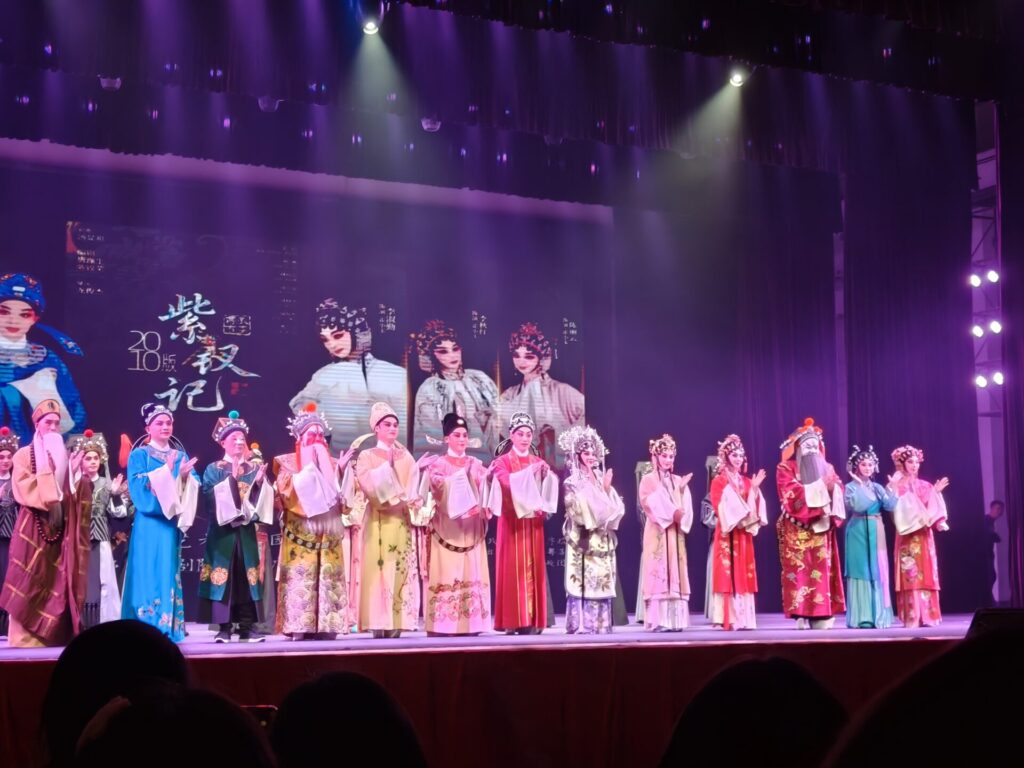
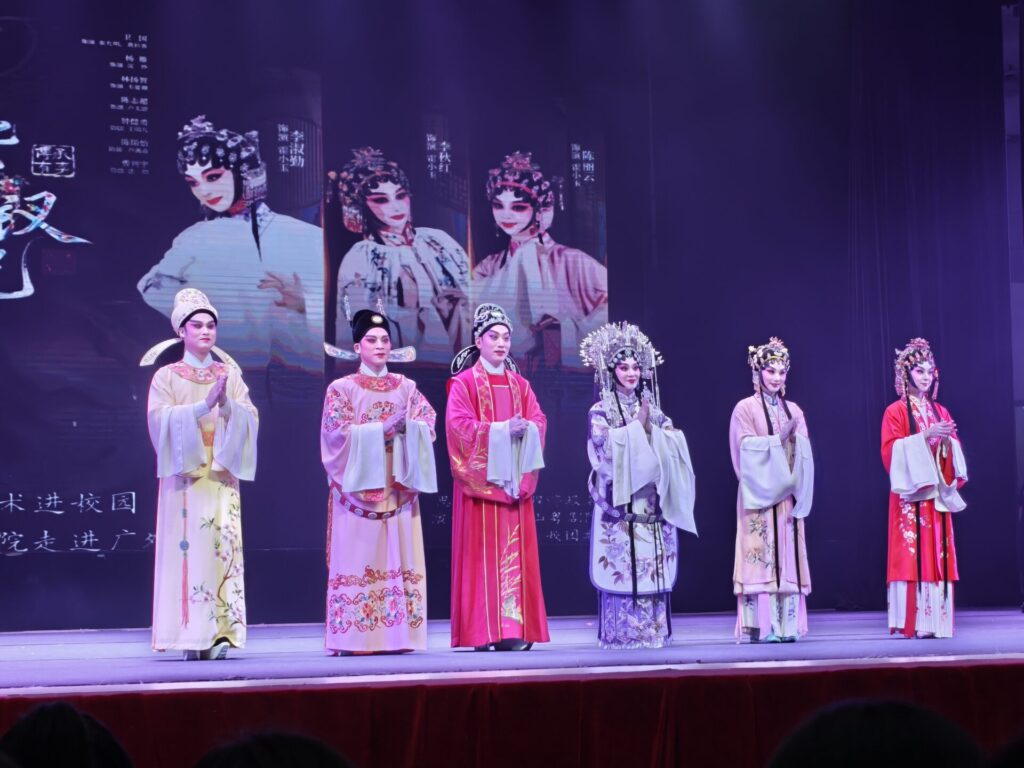
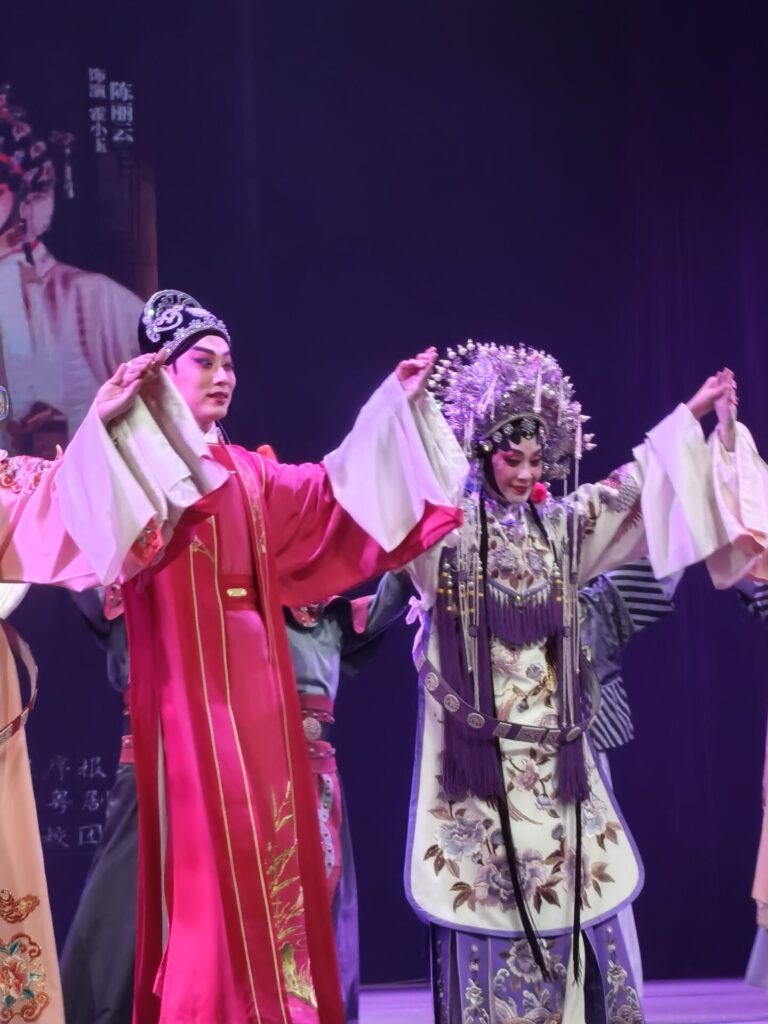
One of the first things I noticed in the performance was the way everyone moved. When the actors moved across the stage, they took small steps, and they moved so that they glided rather than bouncing. It gave the impression that everyone was floating across the stage. The female and male actors did this, but I noticed it most with the male characters because there were several groups of male actors in military costumes with swords or staffs. They moved in perfect unison and floated rather than walked on the stage.
After the performance, I was talking to my students, and one of them said that she had learned Cantonese opera a bit when she was 6 or 7 years old. But she only got as far as learning how to walk. It’s very difficult and requires lots of practice. I can’t imagine how long those actors practiced to be able to walk so gracefully and smoothly.
I also enjoyed listening to the music. The tones were still sharp and a bit strong, but the sounds seemed more mild than what I sometimes heard on the street. But one of the most interesting parts of the music was the clacker. I kept wondering and trying to figure out if the instruments were live or recorded. There was no orchestra pit, but I wondered if the instrumentalists were off to the side, behind the curtains but still able to see the stage. This clacker often matched the movements of the actors.
Sometimes, rather than gliding, the characters would make small deliberate steps. Many times these steps were accompanied by a click or clack from the instruments. I think the instrumentalists must have been watching and matching the sound to the movements of the actors, but that’s a bit of my own speculation.
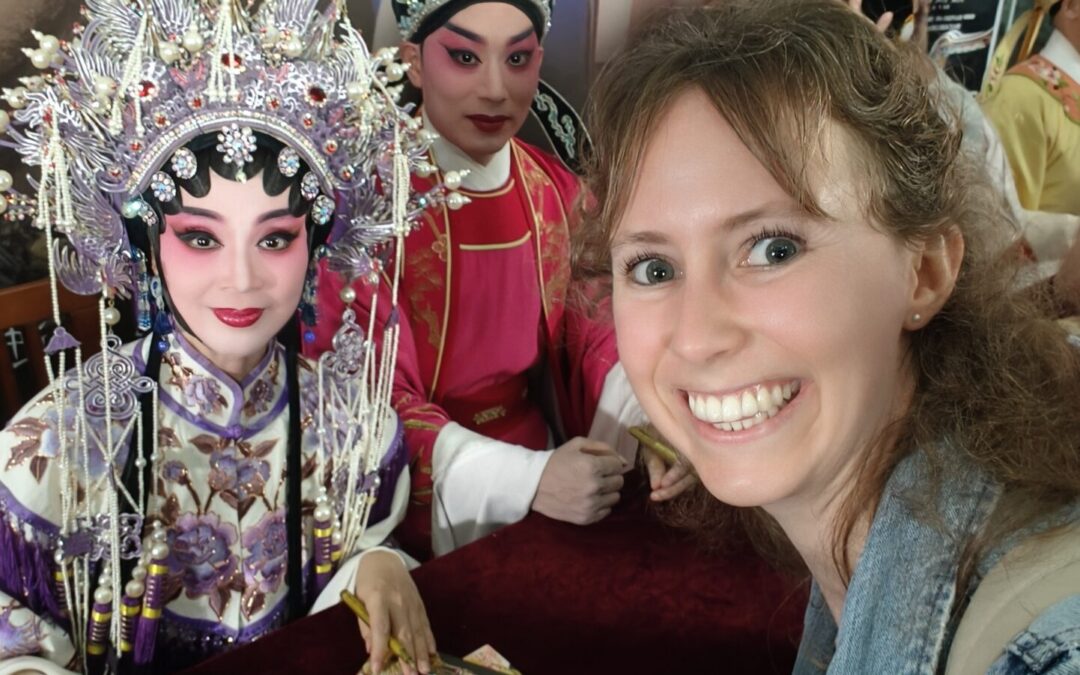
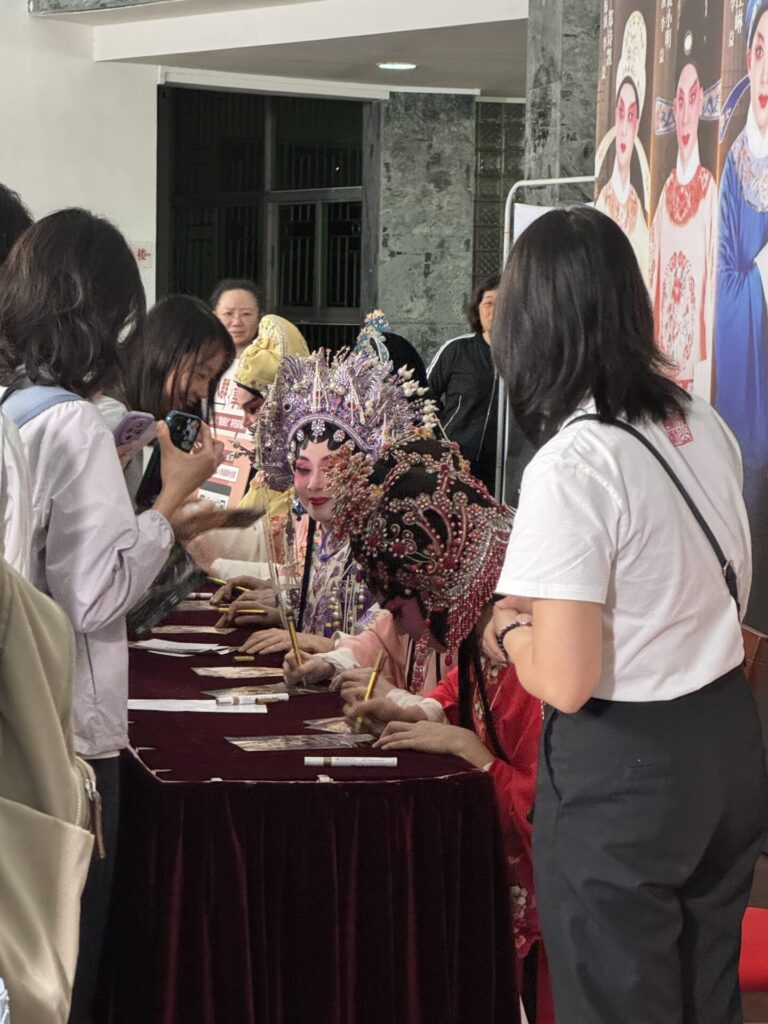
The performance was a bit long, and my brain was pretty tired, but when it finished, we found out that we could go and meet the actors and get their signatures and pictures with them. Kendra and a couple friends left, but I felt new energy, so I decided to stay with my students and wait in the line.
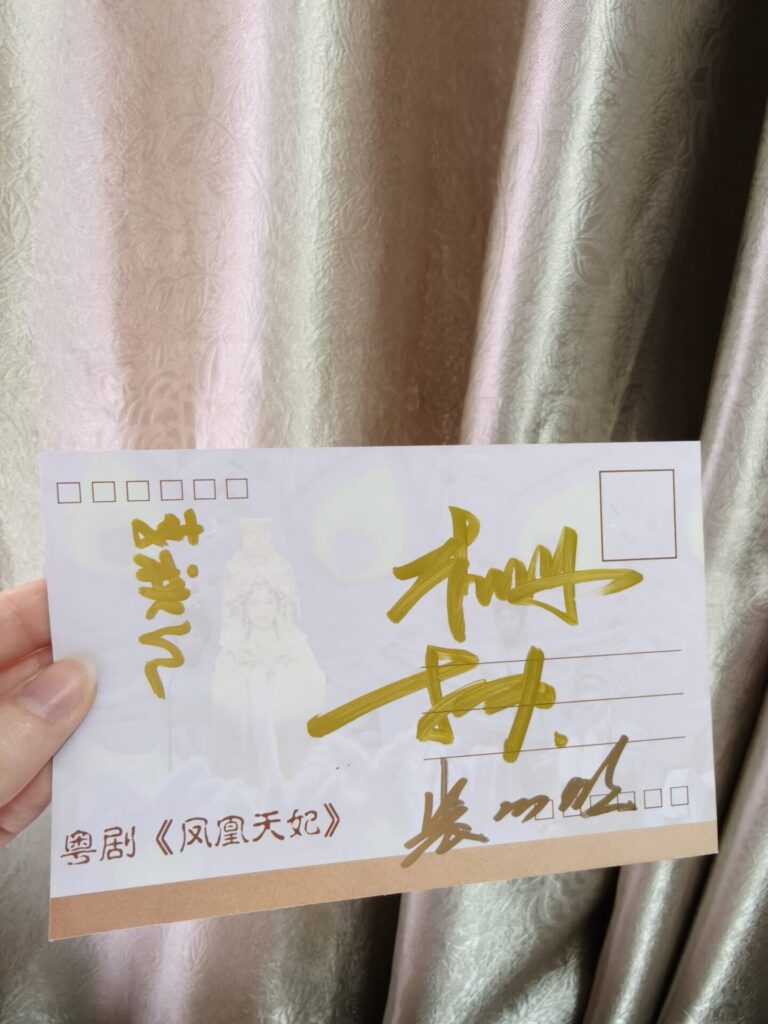
While we were waiting, someone came up and asked me if I would be willing to have an interview about the performance. After we got the signature and a picture with one of the actresses for Xiaoyu (we wanted to get a picture with the girl in the purple outfit, but the lines were confusing and we ended up in the wrong one). We headed off to the side, and someone pulled me aside for the interview.
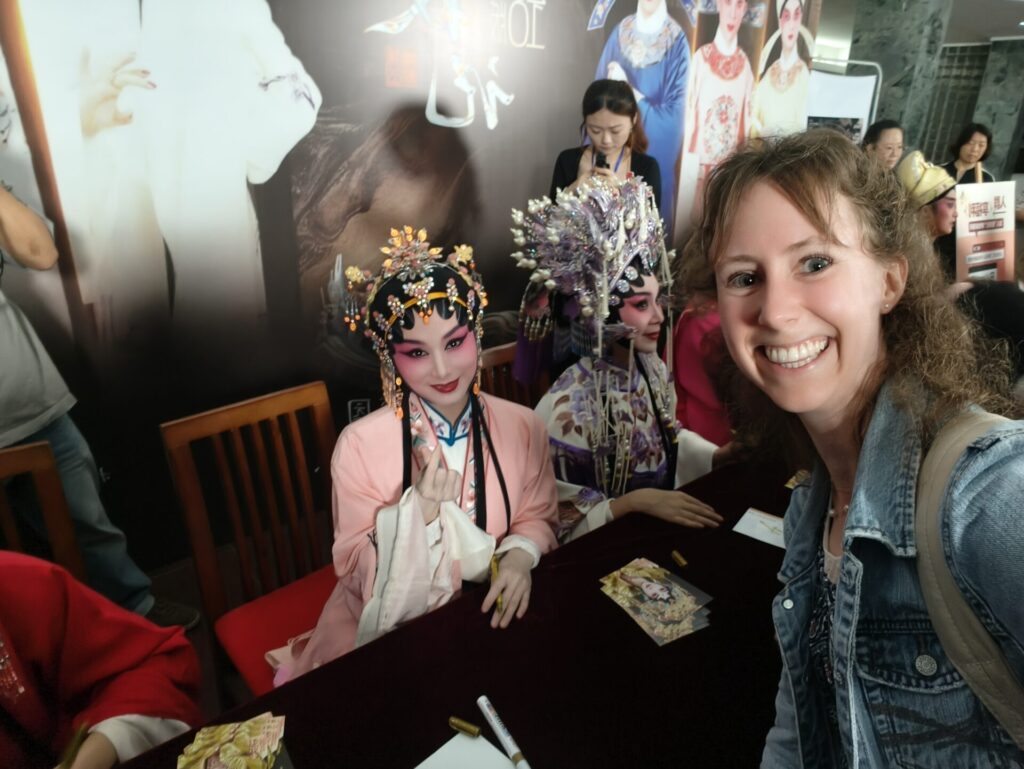
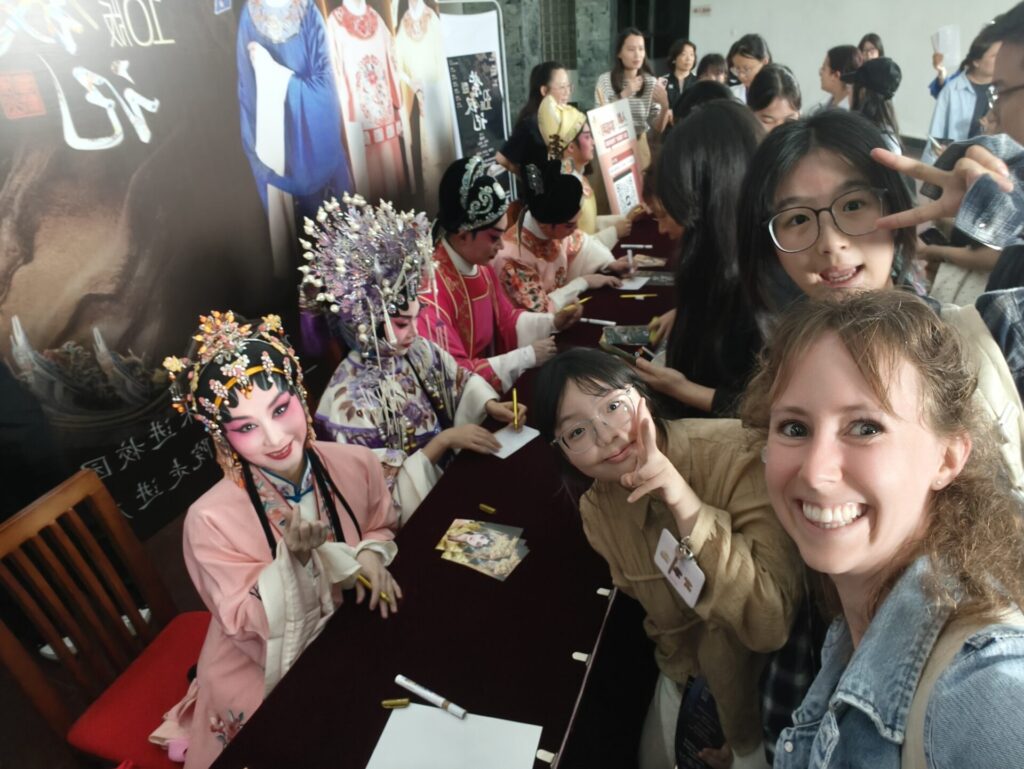
I’m not sure who was doing the interview, it might have been someone with our university since the university was hosting the group to perform the opera. They asked me how I liked the opera and how it compared to Western opera. For that, I focused on the music, but really every part of the performance is different. Maybe the only similarity is that many Western operas are also about love and romance. But the music, clothes, and way of moving are all quite different, and I love experiencing something so different from anything else I experienced growing up in America.
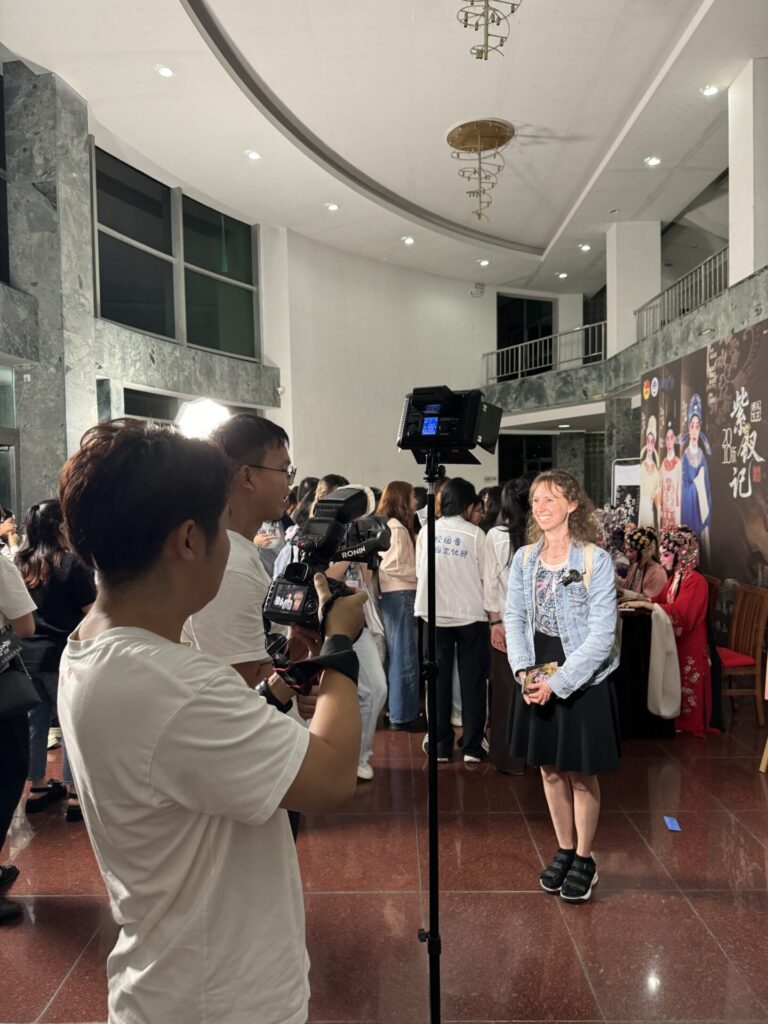
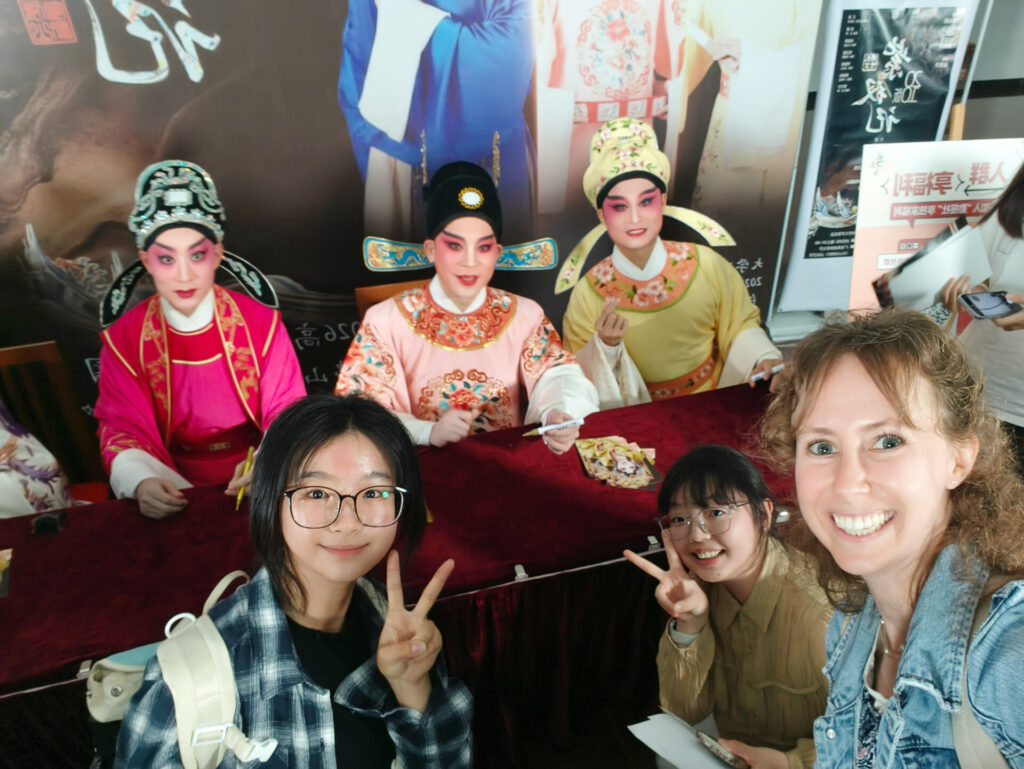
After the interview, the crowd was much smaller, so we got in line and got autographs from and pictures with the rest of the actors and actresses (except for one of the leading female characters). Only the 6 leads for the 2 main actors were available for pictures, but it was fun to meet them. Some of them are famous in the Cantonese opera world.
I was nervous about what to say to them, but my students encouraged me to just say that I loved the show and their acting was amazing, so I focused on that. The actors and actresses were very gracious and invited me to go to Foshan to see more Cantonese opera. Foshan is a city near my city and that is where this group was based.
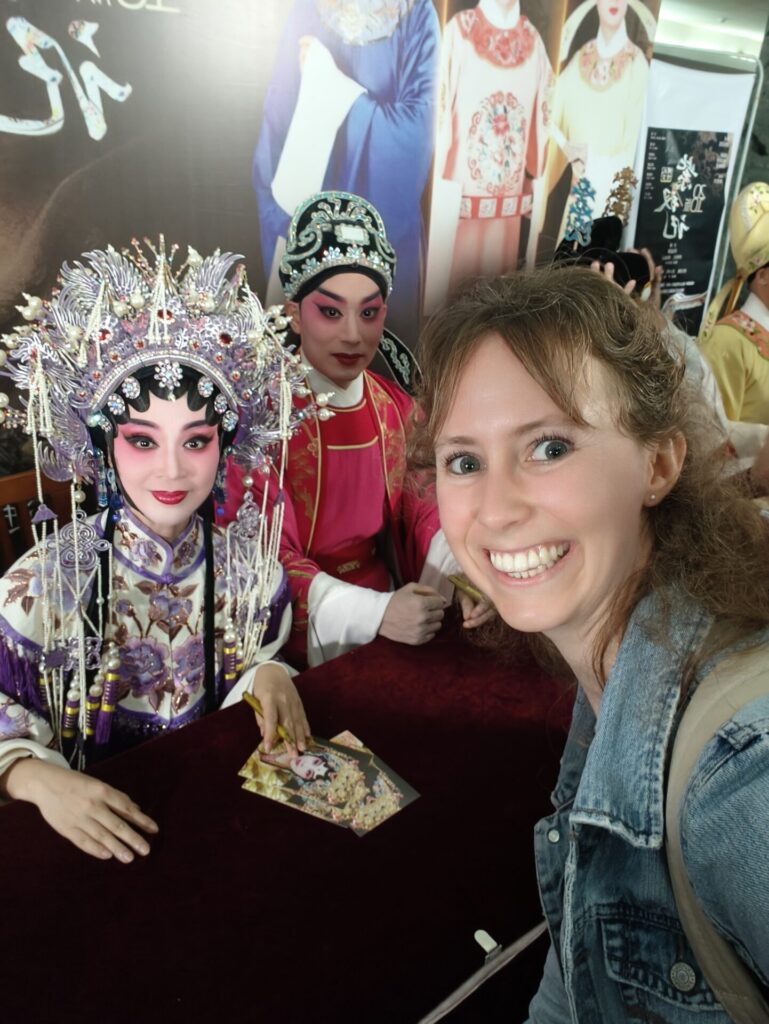
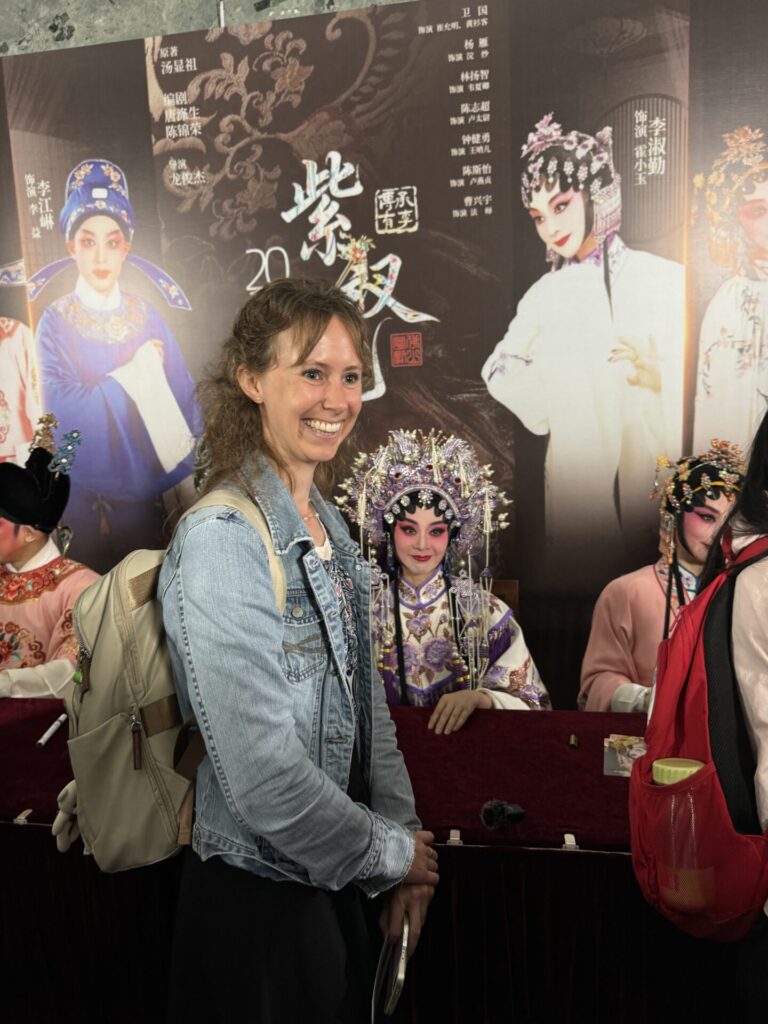
Finally, my students and I had met and gotten pictures with most of the people that we could, so we headed back home. I’m so thankful that my school makes these performances available for students and teachers. I love learning about this culture, and I love getting the chance to spend time with my students as well!