
In the Chinese literature class that I’ve been auditing, we spent several weeks looking at Tang and Song Dynasty poetry. I never imagined that I would enjoy poetry from these periods. I can barely understand English poetry unless someone explains it to me, but the more that I study and understand these poems, the more I’m amazed at the depth of beauty and truth in just a few characters.
One of the biggest reasons that I started enjoying and appreciating this poetry more is that I started watching short videos explaining the poems. The teacher told us to look over a couple of poems so that we could be prepared for the coming class. Sometimes when she tells us this, I’ll just look up the poems on the Chinese AI and ask for an English explanation of the poem and key lines, but one time, I searched for the poem online, and on a whim, I clicked on the video search options. I found a five- or six-minute video explaining one of the short poems, and after watching it, I realized that I could understand some of it.
My favorite video series is called 语文大师 (yu wen da shi; Language Teacher). I really like these videos because they’re short and interesting. At the beginning of the video, the speaker will read the poem. Then she will explain the background of the poem with visuals to help me follow it. Next she will go through the poem line by line, explaining difficult words and the meaning of the full line. At the end, she will read the poem again.
When the teacher assigned the students to give a presentation about a poem from the Tang Dynasty, I watched a video about the Du Fu poem that I chose. The poem is called 春夜喜雨 (Chun Ye Xi Yu; Literally: Spring Night Happy Rain), and it’s beautiful. The second time I watched the video, I paused it many times to look up words and make sure that I really understood what she was saying.
I really like this poem, but I’m getting distracted from the main poem I want to share with you today. Once I had found this method of watching videos to explain the poems, I felt like a whole new world had opened up before me, and I started watching other videos about poems, seeking to understand the background and the meaning of these poems.
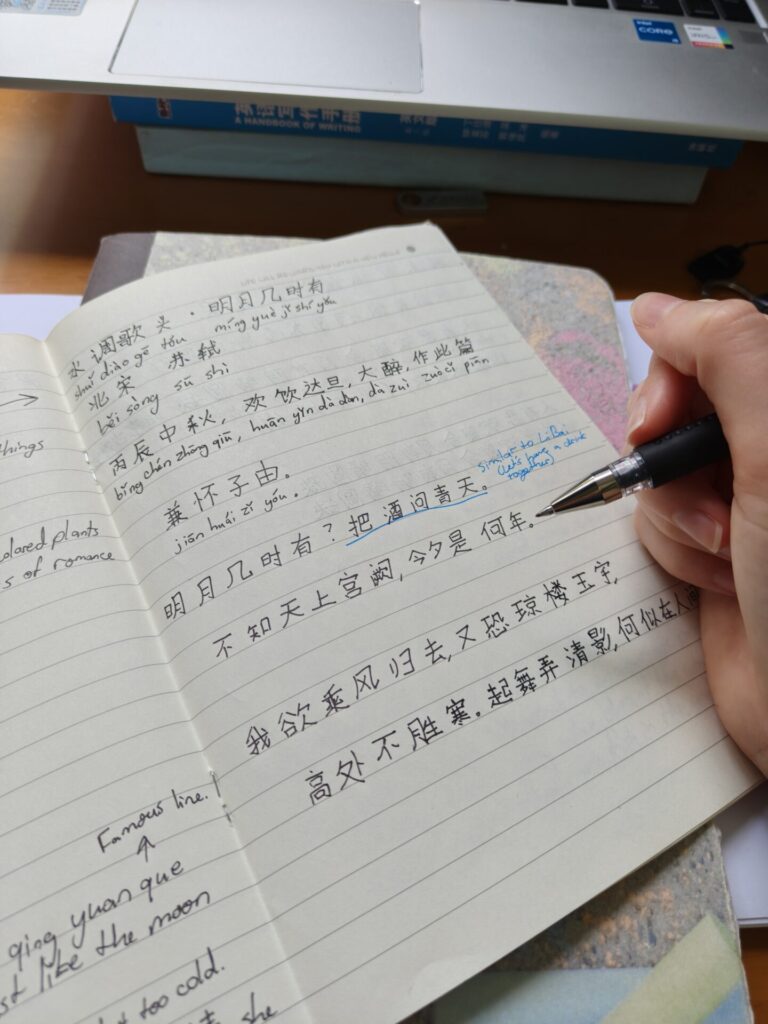
But when the teacher assigned us to look up a poem called 水调歌头·明月几时有 (shui diao ge tou, ming yue ji shi you), the video series that I liked didn’t have a video for this poem. So I tried to find another video, but most of the videos were just people reading the poem with nice music and a pretty background. But I found one video of a guy talking about the poem with the poem in the background. I listened to the video and caught a bit of what he was saying, but he spoke pretty fast, and I hadn’t been exposed to the poem before. Also, this video was just showing the man as he spoke, so there weren’t any visuals to help me understand. I watched some more videos and then learned about it more from the teacher in class, and today, when I went back to that first video, I found I could understand a lot more of it and enjoy the truth and beauty of what he was saying.
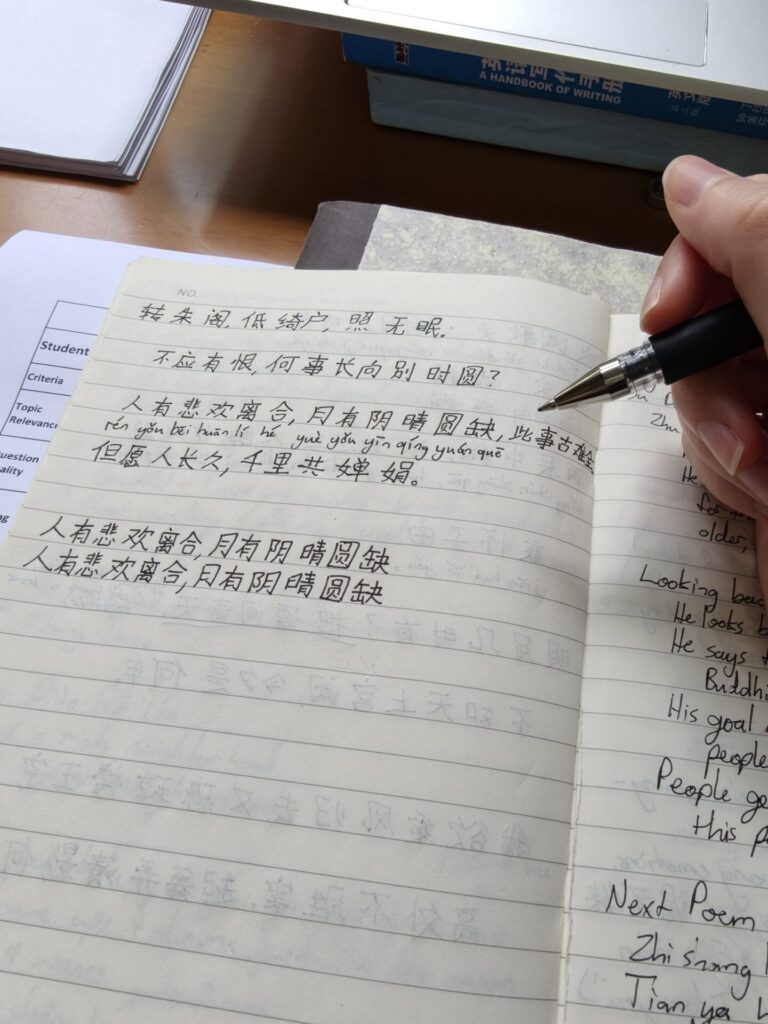
My favorite line in this poem is: 人有悲欢离合,月有阴晴圆缺 (ren you bei huan li he, yue you yin qing yuan que). According to the guy in the video, this line is one that we can’t understand until we’ve been walking on the road of life for a while and have experienced the ups and downs like the author, 苏东坡 (Su Dong Po) had. Actually Su Dong Po is his pseudonym. His name is 苏轼 (Su Shi), and you might see either of these names in reference to him now.
Su Dong Po’s life was full of ups and downs. His career was looking good early in his life, and he was having some success when his mother, whom he loved, passed away. According to the custom of the time, he needed to return and pay his respects for three years. After that, he went back to his civil service work, and after working hard to get back into everything, his wife passed away. Not long after that, his father also passed away, and he needed to return to his hometown to pay his respects for another three years. By the time he finished all these periods of mourning, the situation for his career was not as smooth.
His life had lots of ups and downs. So let’s look at what this line means. 人有悲欢离合 (ren you bei huan li he) means that people have sadness (悲,bei), happiness (欢, huan), separation (离, li), and togetherness (合, he).
But Su Dong Po doesn’t stop there, he compares the ups and downs of our life to the moon. Poets from this period loved the moon. They love the beauty and the romance of the moon, but here, Su Dong Po focuses on the constant changes the moon goes through. 月有阴晴圆缺 (yue you yin qing yuan que). He’s saying, the moon has darkness (阴,yin), clarity (晴,qing), waxing and waning (圆缺,yuan que). I love this imagery. Sometimes the moon is bright and full, and sometimes life is good and beautiful and everything feels perfect. And sometimes the moon is completely absent from the sky and everything is covered in darkness. Hope feels just as absent as the moon while we try to find our way in the darkness.
Only someone who had endured hard times could write something like this, and the more that we have experienced our own dark times, the more deeply we can understand the beauty of this line.
Last week, a good friend of mine had a baby. Having a baby is such a beautiful thing, but you can’t have a baby without hours of pain and months and years of sacrifice before and after the baby is born. Sometimes the ups and downs come right on top of each other, but sometimes, like the moon, the periods are more drawn out. Perhaps we have a period of heartache when our hopes come crashing down. Perhaps we have a period of joy when our hopes are realized.
I have seen these periods of joy and sorrow in my life. I have had periods of separation from people that I love (I hate goodbyes), but I have also had beautiful times of fellowship and community (that’s probably what makes the goodbyes so hard).
Would I trade the ups and downs for a life that is flat and devoid of that pain? In my European Culture class, we talk about John Keats’s “Ode on a Grecian Urn.” My favorite stanza is:
“Bold Lover, never, never canst thou kiss,
Though winning near the goal yet, do not grieve;
She cannot fade, though thou has not thy bliss,
For ever wilt thou love, and she be fair!”
After we read the stanza and I explain what it means, I ask the students if they would want this kind of love, a love that never fades but is also never realized. The last time I talked about this in one of the classes, the students mentioned that they wouldn’t want this static kind of love because life is full of beautiful and hard times, ups and downs, and they wouldn’t trade those ups and downs for a static love that doesn’t have the hardships, but also misses much of the beauty.
Life is full of hard times, and while I don’t particularly enjoy the hard times, the pain makes the joy that much richer. Or maybe the pain makes the joy more terrifying because we know that if we feel happy, then something hard is just around the corner. Sometimes I have found myself battling this fear.
At this point, in my thinking, I can’t go any further without talking about how much I need my God. All of the most beautiful literature points us to Him, and these ideas about beauty and pain and separation and unity are no different.
One of my favorite psalms for when I am going through dark times is Psalm 139 and I think that verses 11 and 12 are particularly relevant to this discussion: “If I say, ‘Surely the darkness shall cover me, and the light about me be night,’ even the darkness is not dark to you; the night is bright as the day, for darkness is as light with you.” When I’m in my darkest times, I can rest in God because my darkness isn’t dark to Him. He hasn’t left me. He is walking right beside me. When the moon is absent, my God is still there. Another favorite, Psalm 23 reminds me, “Even though I walk through the valley of the shadow of death, I will fear no evil, for you are with me; your rod and your staff, they comfort me” (verse 4). I’m not alone even in the darkest times.
Right now, I’m not in a particularly dark time. It’s easier to “Give thanks to the Lord, for he is good, for his steadfast love endures forever” (Psalm 136:1). And even though I know that dark times will come again, I have found that God’s grace is always sufficient for today. “Therefore do not be anxious about tomorrow, for tomorrow will be anxious for itself. Sufficient for the day is its own trouble.” (Matthew 6:34). Or when Paul begged God to take away some hard thing, God responded “My grace is sufficient for you, for my power is made perfect in weakness.” (2 Corinthians 12:9).
Even though I’m tempted to worry about those coming hard times, I don’t have to because all of my days are in His hands, and He is walking with me in the good and the difficult times. He won’t leave me during either one. So as I watch the moon wax and wane, and as I enjoy the ups and downs in life, I can praise my God for never changing and for walking with me through it all.