
This semester, I had a dream come true—a good dream! During my first year teaching in China, more than a decade ago (Yikes! It feels weird to say that!), I taught spoken English for English majors. I loved it. We had lots of fun practicing random role plays and talking about different topics. But when I heard that those English majors also had a Shakespeare class, I wished I could teach that one instead of just spoken English. But it was not to be, yet. I continued teaching spoken English for many years, with quite a bit of IELTS speaking practice thrown in as well.
Several years ago, I got a job in a foreign language university, and now I get to teach content-heavy subjects rather than just spoken English. I love teaching European culture in the fall and helping the students to fall in love with European art and helping them to understand the history behind the culture. I also taught Advanced Writing for a couple of years which I enjoyed, but the grading for that course was pretty heavy. At the end of last semester when the office informed me that I wouldn’t be able to teach Advanced Writing and asked if I could teach Shakespeare in Movies instead, I jumped at the chance. Finally, I could teach Shakespeare!
I spent almost all of last winter break watching Shakespeare movies, reading Shakespeare’s plays, and thinking about how I would make Shakespeare accessible for Chinese students. One of the most influential books that I read was How to Teach Your Children Shakespeare by Ken Ludwig. He encouraged parents to explain key Shakespearean lines to their kids as they told them the story. He also encouraged parents to help their kids memorize the speeches in fun ways with games and lots of repetition. I decided not to require my students to memorize speeches, but I did help them to learn several key lines from each play that we discussed.
After watching at least a dozen movies and play adaptations and searching for countless others, I’d like to share some of the ones that I found so that you can also enjoy learning about Shakespeare and thinking about the stories and themes and how different movies express those themes in different ways. I’ll include links for the movies if you have access to Chinese streaming services. Many of them are free, but a couple of them require memberships.
1. A Midsummer Night’s Dream. I started with this one because it’s fun and a bit crazy, and it’s a comedy, so it has a happy ending. I wanted to start off with something light. For the movie, I had the students watch a movie called Strange Magic (2015). This is a cartoon that focuses on the plot around the love potion and what happens when you give people (or bugs/butterflies) a magic potion, forcing them to fall in love with you. The movie is cute and fun, and I enjoyed it. In class, I talked with the students about some similar themes as well as some differences between the movie and the play.
When I taught the students the play in class, I made character cards with the name of the character, a description if necessary, a little person showing if the character was a boy, girl, or could be either, and a picture/symbol to represent something important about that character. I usually used DeepSeek for help with the symbols, and it often had good ideas. As I told the story of the play, I had students hold the character cards, and I moved them around the stage or sometimes around the classroom as I explained what happened. The students had fun with it and sometimes got into miming the actions that I described.
In class, I read key scenes with the students and explained the key lines and important imagery. I also emphasized the lines that I wanted the students to remember (especially lines that most native English speakers will know and recognize). After we read a scene together and I explained what was happening and what the characters were saying, I would show the students the scene from a stage play or a movie that used the same language as Shakespeare. I tried to find versions with Chinese and English subtitles so that the students could follow the lines even more. In class, the students really enjoyed the version of A Midsummer Night’s Dream by RSC that I found. They laughed at all the right moments, and one student told me after class that she had fallen in love with Shakespeare from the class. That made my teacher’s heart very happy! I didn’t get a chance to watch the whole movie, but I watched the scenes that I showed the students, and they were well done.
2. Hamlet: Prince of Denmark. I love Hamlet, and the students enjoyed learning about this story also. It’s quite a bit darker than the comedies, but the students did well in learning about the story and understanding the key scenes. I had the students watch Lion King (1994) (also on Tencent and Bilibili). Most of them had already seen it, and they were surprised that the story was the same as Hamlet, but we had a good time talking about similar themes and understanding the similarities and differences.
In class, we watched a Kenneth Branagh (1996) movie version of the play to help the students get a vision for the different scenes. For Hamlet, I focused a lot on Hamlet’s soliloquies since those are the most famous, but I was struggling for a while to know how to teach the “to be or not to be” speech. Suicide is a touchy subject, and I wanted to approach it in a safe and healthy way. I finally decided to explain the speech the way it was: Hamlet wanted to commit suicide, but the thing holding him back was his fear of death. Hamlet was struggling with a lot of difficulties in his life, and he was tired of fighting everything. In the discussion time, I asked the students what advice they would give to Hamlet. I also asked them what advice they would give to a friend if they knew that their friend was struggling with hard times. Finally, for homework, I asked the students to write a letter to their future selves. I pointed out that we all face really hard times, if not now, then they will come in the future. So I asked them to write a letter of encouragement to their future selves. I just gave a completion grade, and I really enjoyed reading the letters that the students wrote. Some of them shared really personal things, and I was able to have some deep discussions with some of the students about struggles that they were dealing with that semester. I’m proud of my students and how they face difficulties courageously.
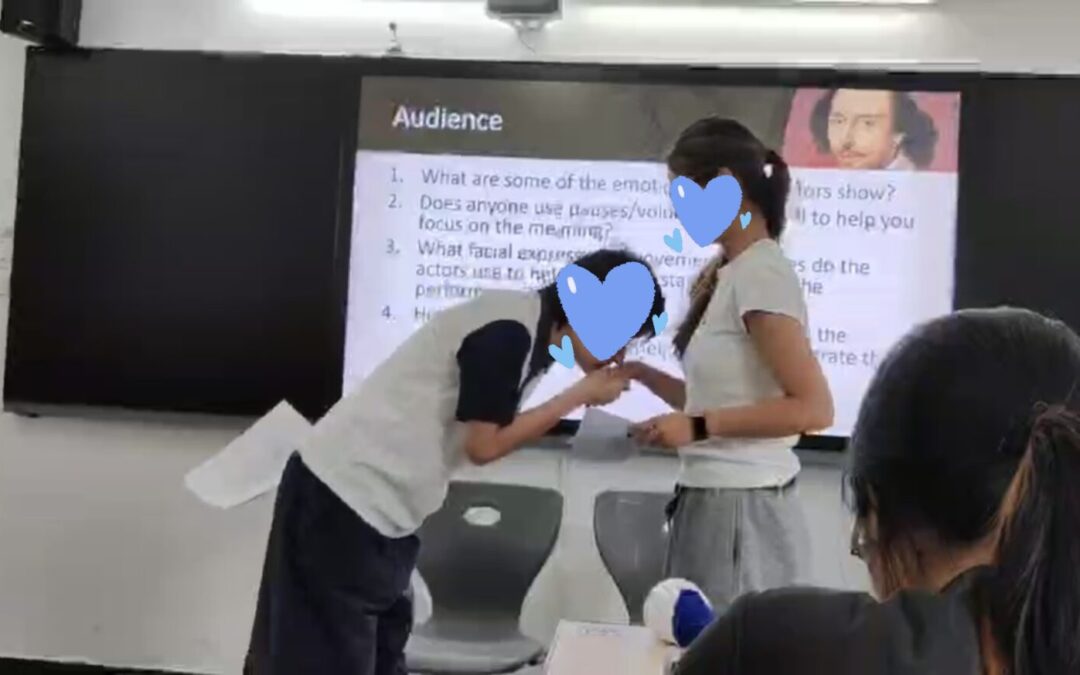
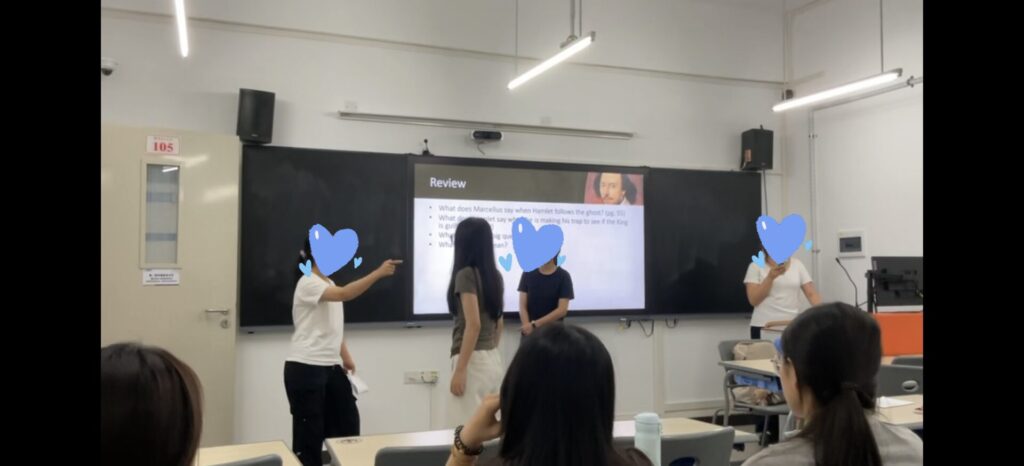
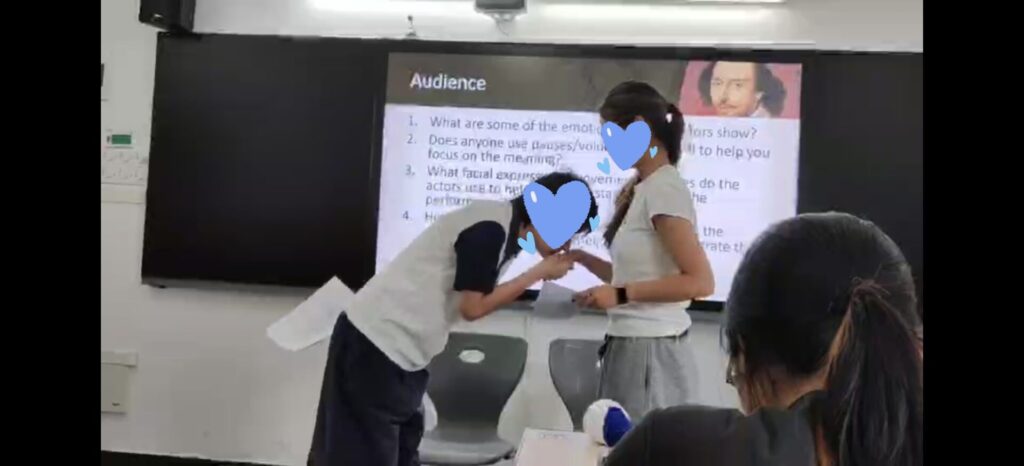
After discussing the first two plays, we took a week off for performances. I wrote down all of the scenes that we had discussed and gave the students the choice of which one they wanted to perform. I didn’t require them to memorize the scene because I felt like that would be too difficult, but I told them they needed to be very familiar with the lines. I encouraged them to use facial expressions, gestures, movement, volume, pacing, and intonation to show me that they understood the lines and could express everything to us. But I also encouraged the students to have fun, and they did! We had a great time with these performances, and it was fun to watch the students get into the story.
3. The Tragedy of Romeo and Juliet. This is not one of my favorite Shakespeare plays, but it’s probably the most famous, so I felt like I should talk about it. I gave the students two movies to watch, and told them they could choose which one they wanted to watch. One of the movies was the older Westside Story (1961), and the other was an older movie version of Romeo and Juliet (1968). Almost all of the students chose to watch the movie version, and only a couple watched Westside Story. I couldn’t find the newer version of Westside Story, but I told them they could watch that one if they could find it. I also gave the students an extra movie to watch because I wanted them to think about the story from another perspective–that of Rosaline, Romeo’s initial and quickly forgotten love. Rosaline (2022) is a fun comedy/romance movie.
In class, I showed the students clips of the Leonardo DiCaprio movie version of the play: Romeo + Juliet (1996). We had some good discussions about the emphasis on passion rather than thinking through choices, and we also talked about how Romeo and Juliet both felt misunderstood by those around them.
4. Twelfth Night. I really enjoyed this one, and we had a good time talking about the different scenes. For the movie, I told the students to watch She’s the Man (2006). They enjoyed this one, and I think this one was interesting because it brought the story to a school which was a bit closer to their lives.
In class we watched a couple of versions of the play. The first one I found was good, but it didn’t have any subtitles, and the students were struggling with it a bit. Once I found a version with subtitles, they enjoyed it a lot more. National Theatre Live: Twelfth Night (2017). I didn’t watch all of this one, but the scenes that I watched with the students were fun and well-done.
5. The Tragedy of Macbeth. We’re starting this one today, so we haven’t finished talking about it, but I’m looking forward to talking with the students about the power of ambition and how a husband and wife can support each other for good or evil. This is definitely a dark play–I mean, spoiler alert, but it ends with Macbeth’s head in a bag on stage! Since the students are busy working on adaptations of one of the Shakespeare plays for the final exam project, I decided not to require them to watch a movie for Macbeth. Also, I was having a hard time finding adaptations of this story. I found a BBC version that adapts the story to a restaurant setting where Macbeth is the head chef, but it doesn’t have subtitles, and the Scottish accents make it a bit hard (even for me sometimes) to understand. So I’m going to give it to them and say they can watch it, but they don’t have to.
I’m really excited about the students’ adaptations of the plays. I told them they need to choose a story and adapt it to the setting of our university. I heard their ideas and outlines last week, and they’re supposed to turn in the first draft today! Looking forward to seeing their ideas in script form because they are pretty creative! Perhaps I will share them with you sometime in the future!
If you ever need to teach Shakespeare in Movies, or if you just want to understand Shakespeare more for yourself, I hope you enjoy these movies, and please let me know if you have any other recommendations! 10 Things I Hate about You is also a fun movie based on The Taming of the Shrew, but I decided to skip that play for our class. So many plays, so little time!