This semester, I decided to join one of my roommate’s Chinese classes. When she told me that one of her classes is Chinese Literature, I was pretty excited as that is a topic that interests me. Really, literature from any culture is interesting to me, but since I’m living in China, and I have the chance to learn about literature from a Chinese teacher, I wanted to join.
I showed up at the first class and recognized several of Kendra’s classmates from the guys that I play soccer with and other friends I have met through Kendra. When the teacher arrived, I asked her if I could audit the class, and I was thrilled when she agreed.
I settled in to try to learn something. That first class was a bit rough because while Kendra had sent me the information for this class, I hadn’t prepared for it much, and I struggled to follow the teacher as the students read ancient Chinese poems and then the teacher talked about what they meant. I struggle with poetry in English, and poetry in Chinese tends to cut out lots of words, so there is a lot of context that you need to understand in order to understand the poetry. Also, lots of the words are not commonly used, and I didn’t know many of the meanings.
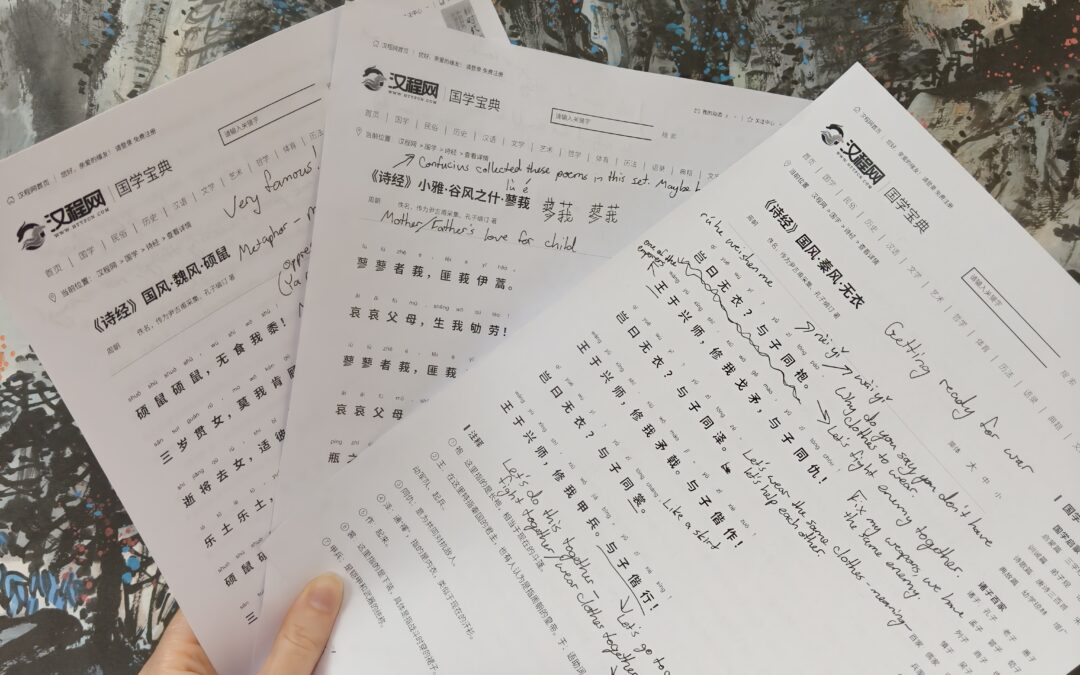
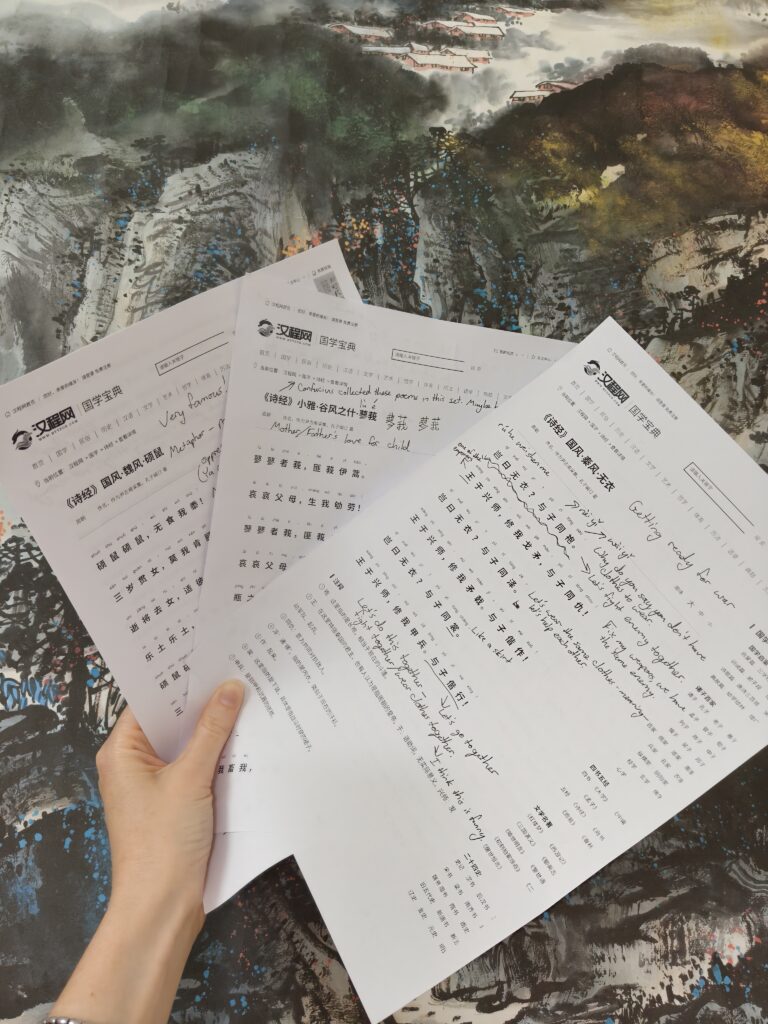
To prepare for the second class, I printed off the poems we were still going to cover. For me, having a piece of paper in front of me that I can write on always makes it easier to follow what the teacher is saying. I tend to take my notes in English because I can write much faster and I can make sure that my notes will be decipherable when I look at them later. I can’t write most Chinese characters without looking at them, and pinyin is sometimes hard to understand when I read it later since a pinyin word could have several different meanings.
Today, I’m going to share some of the poems that I think are interesting and some of the famous lines from those poems. Hopefully then you can also enjoy them, and I’m also counting this as my writing time and my Chinese study time, so it’s a win-win for me!
These poems are all from 《诗经》(Shi jing; The Book of Songs). This is the earliest collection of poems in China. According to my Chinese teacher, these poems were collected by Confucius who lived from 551-479 BC. He may have collected all of the poems, but he may also have only collected his favorites. Since we don’t have other records from that time, we don’t exactly know for sure. Perhaps some poems were lost–ahh, the mysteries of life.
There are several different sections within The Book of Songs, and I will include those so if you want to look them up, maybe they will be easier to find.
1. 《诗经》小雅·谷风之什·蓼莪 (Shijing; xiaoya; gufengzhishen; lu e)
I should note here, that I did use DeepSeek, the Chinese AI to check some of my understandings of the poem, and since they agreed with what I thought the teacher was saying, I trust what I found.
This poem is about the relationship between a child and his/her parents. The title of the poem means “Tall Sagebrush” (from my dictionary) or “Lush Gossefoot” (according to DeepSeek) which DeepSeek claims is a comparison between a strong and healthy plant and weak and fragile parents. If the teacher mentioned this, I missed it, so on this point, I’m not sure about the accuracy of DeepSeek. On other points, my teacher and DeepSeek said the same or similar things.
The child has a lot of regret that he can’t repay his parents for all that they did for him. The following are some of the most famous and according to my teacher quite beautiful lines. I also like the sound of the lines. They have a beautiful rhythm and lots of repetition at just the right moments.
“父兮生我(fùxīshēngwǒ),母兮鞠我(mǔxījūwǒ)。拊我畜我(fǔwǒchùwǒ),长我育我(chángwǒyùwǒ),顾我复我(gùwǒfùwǒ),出入腹我(chūrùfùwǒ)。“
The repetition of “wo” which means “me” here is beautiful. Here the speaker is listing all of the things his parents have done for him. They gave birth to me, they took care of me. They loved me. They supported me. They helped me. They taught me. They protected me. They hugged me when I came out, and when I came in.
Our parents do so much for us. The poet here recognizes all that his parents have done for him, but he mourns his inability to repay them for their great sacrifice.
In China, filial piety is an essential part of the cultural make up. Children are taught to respect and honor their parents. In another post, I discussed another story that I read, also about the sacrifices of a parent for his son and how his son struggled to honor his father as he felt like he should.
Children are often expected to care for their parents financially once they have stable jobs. This is not always the case, and I’ve seen many exceptions, but in general, children are expected to respect and honor their parents, and this often shows up in financial ways.
In my culture, we are also taught to honor our parents, but the ways of doing that are not as consistently financial. I am terrible at giving gifts (I’m amazed at how creative many of my Chinese friends are in giving gifts), but I try to call my parents consistently. I enjoy talking about these cultural differences with my students, but I also try to remind them that we can learn from other cultures, but we don’t necessarily need to compare our cultures and say that one is better than the other.
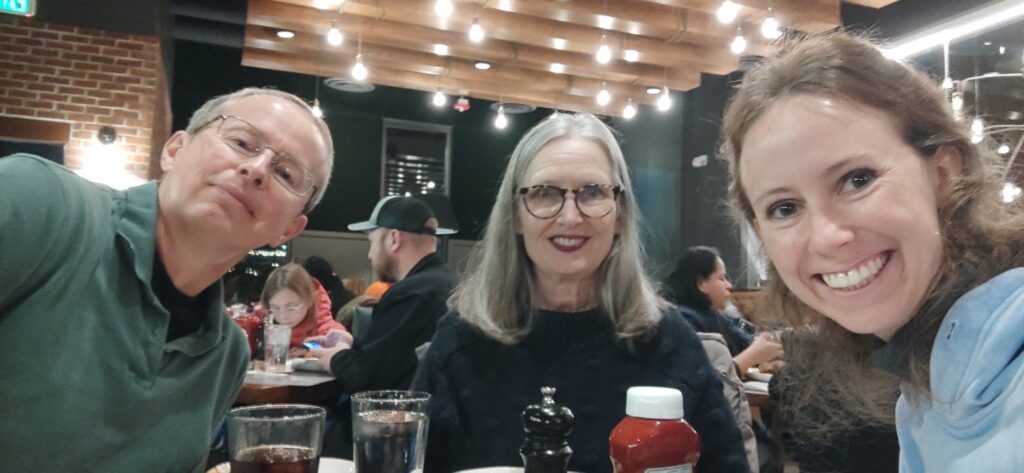
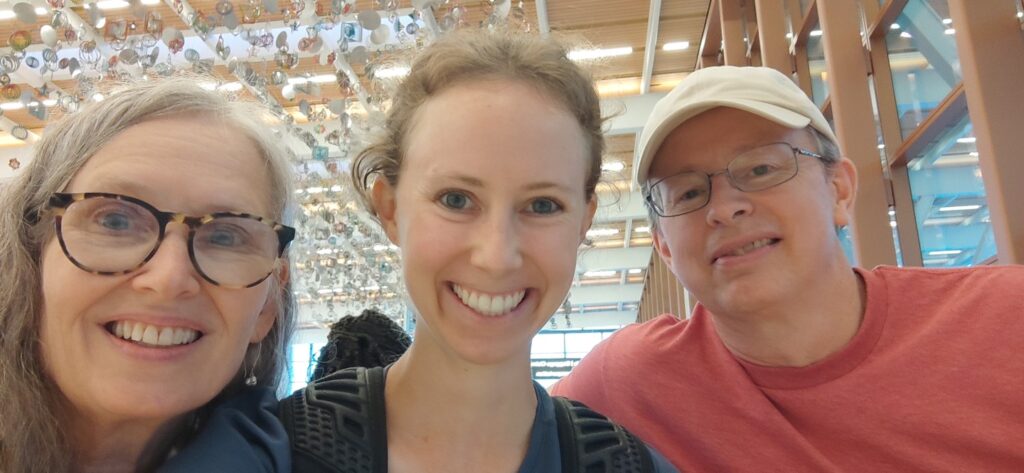
This poem is a also a great reminder to be thankful for my parents. They are incredible people, and I’m grateful to all the sacrifices that they have made for me, and I’m thankful that they support me and love me even though I’ve chosen a rather unconventional path for my life. Dennis and Ruth Mullins are people that I love and admire and respect, and I don’t say that often enough.


2. 《诗经》国风·秦风·无衣 (Shijing; Guofeng; Qinfeng; Wuyi)
The title of this poem literally means “no clothes.” This poem is about uniting together as the people prepare to fight their common enemy in war. It’s from the Qin period which was one of the Warring States during that period of China’s history.
The first line of this poem is one of the most famous. In fact, our teacher said it was used as a slogan to unite people in later wars also.
“岂(qǐ)曰(yuē)无(wú)衣(yī)?与(yǔ)子(zǐ)同(tóng)袍(páo)。“
This phrase first asks the question: “Why do you say you don’t have clothes (or robes)?” “Let’s share our clothes.” This means that we can fight the enemy together. 同袍 (tongpao) literally means “the same robes or gowns” but in the dictionary, it is translated as “fellow officer; intimate friend; bosom friend.” There is nothing about clothes in the dictionary definition of this word when the two parts are put together.
The poem goes on to get even more personal saying that “we” can also share undergarments and skirt-like articles of clothing. As she taught this poem, the teacher pointed out how ridiculous it is to share undergarments (I think that’s especially true for people long ago who likely only had limited undergarments). She pointed out that they aren’t actually saying they should share clothes, it just means that let’s work together to fight our common enemy.
I like the emphasis on camaraderie in this poem. I have a few friends that I can share clothes with, and those are the friends that I know will stand by me no matter what I am facing. Hopefully, we will not have to face any literal battles in our lives, but we will face many metaphorical battles, and I’m thankful for people who stand behind me and say, “Let’s share our clothes. Let’s do this together. Let’s take our stand together, and let’s fight this enemy (depression, fear, anxiety, hard times) together.”
3. 《诗经》国风·魏风·硕鼠 (Shijing; Guofeng; Weifeng; Shuo Shu)
This poem is also super famous, and when I heard Kendra read it in class, I could see why. The rhythm and flow of the poem are really nice. The four character groupings are really common in this ancient Chinese poetry from The Book of Songs. Even though these limited characters make it harder to understand since two-character words are often cut down to one character, I love the flow.
This poem also has lots of repetition of words and also words with the same sound but different meanings. That repetition makes it a bit difficult to read, but once you get it, the sound is beautiful.
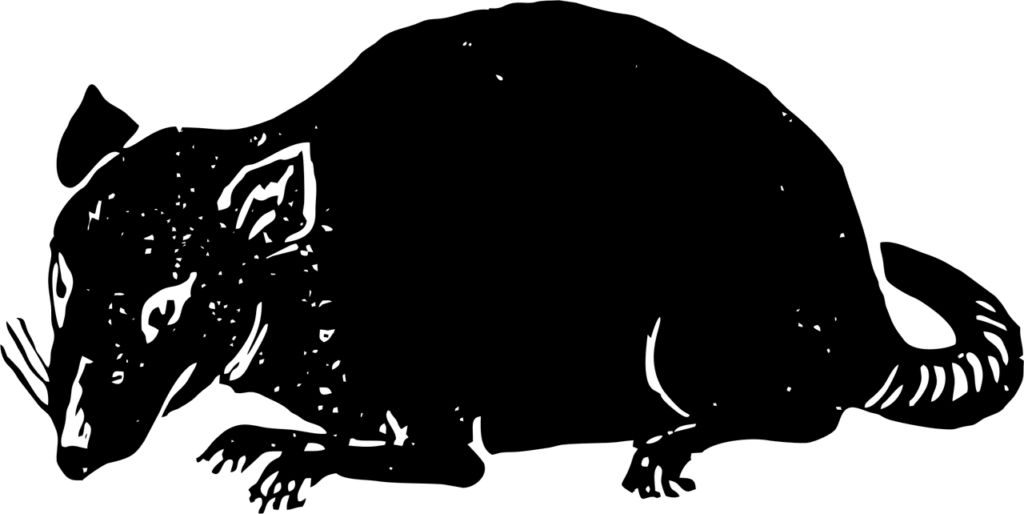
The metaphor in this poem is also very powerful. This poem is called 硕鼠 (shuo shu), which means “Big Rat.” This rat represents the oppressor of the common people. The poem is written from the viewpoint of a commoner who speaks with anger against his oppressor and then longs to visit a happy place.
“硕鼠硕鼠(shuòshǔshuòshǔ),无食我黍(wúshíwǒshǔ)!
三岁贯女(sānsuìguànnǚ),莫我肯顾(mòwǒkěngù)。
逝将去女(shìjiāngqùnǚ),适彼乐土(shìbǐlètǔ);
乐土乐土(lètǔlètǔ),爰得我所(yuándéwǒsuǒ)。“
The first line starts by demanding that the mouse not eat my food. The commoner has served the oppressor faithfully, but the oppressor doesn’t care about him at all. So the commoner decides to look for his satisfaction in an ideal since he can’t find it in reality. This ideal is the “乐土” (le tu) which means literally “happy piece of ground.”
I am so thankful that I am not under oppression today, and I want to look around me and make sure that the things that I buy (food, clothes, and other household items) are not contributing to the oppression of others. In America, buying locally-made products is a big deal for this reason. People don’t want to contribute to oppression in other places by buying from a big company that may not treat their workers well. I think the situation is very complicated, but it’s an interesting thought to consider. Are there any ways that my daily life is contributing to the oppression of others? Do I know that the things that I buy come from ethical sources?
None of us wants to be the Big Rat, but are we willing to ask the difficult questions and look at our comfortable lives and consider if there are any ways that we are taking advantage of people who are less fortunate than ourselves?
I really enjoyed reading these poems from The Book of Songs. I like learning about how Chinese thinking developed, and I like enjoying the beauty of poetry in another language. I’m very excited about this class, and I hope that you enjoy learning a little bit about Chinese poetry as well! Please share any additional insights you have!
Thanks for sharing!❤️
Thanks for reading! 🙂
We will always love you! And admire and respect you too. Thanks for sharing!
Thanks Dad! 🙂